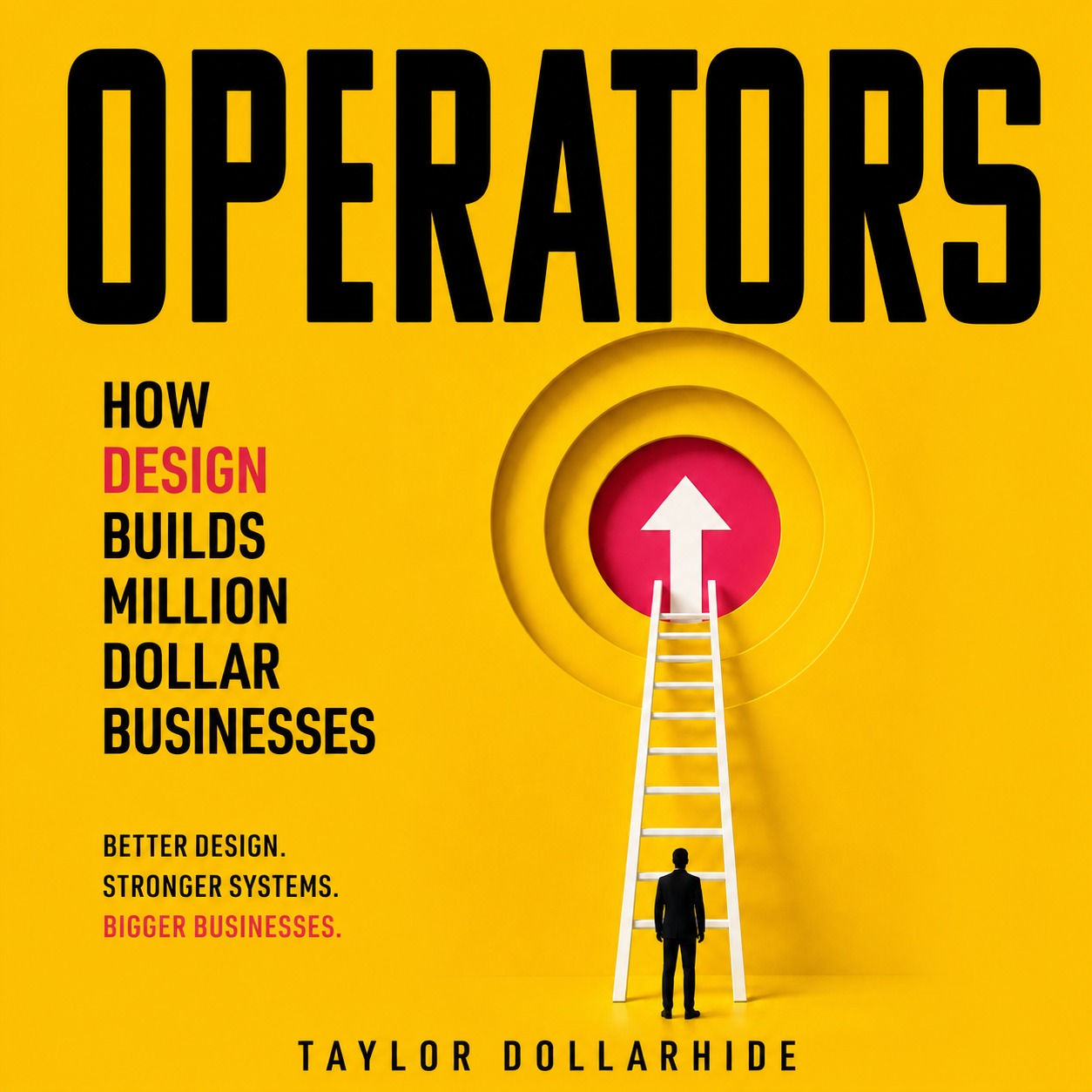
The Operator's Book. A book about design for the people who decide whether design gets a seat at the table.
The chair you're sitting in. The phone in your pocket. The app you opened this morning. Thousands of people spent thousands of hours deciding how those things work, feel, and fit into your life. Operators is the book that explains how design shapes that narrative — and what happens to businesses that understand it versus the ones that don't.
Look around you right now. Every object in your field of vision was designed. Not just styled — decided. Someone chose the weight of it, the angle, the texture, the sequence of steps it takes to use it. Thousands of hours of thought went into things you interact with so naturally you've stopped noticing them.
That invisibility is design working at its highest level. And it's also the reason most executives underestimate it — because when design is done right, it disappears into the experience and you never see the decision. You just feel the outcome.
The Operator's Book makes those decisions visible. It explains how design shapes the narrative of a business — what it communicates before anyone reads a word, what it makes possible that competitors can't copy, and why the businesses that understand this compound while the ones that don't keep starting over.
"Everything in your life was designed. Operators is about who controls that narrative — and what it costs when you don't."
Over 25 years, I've sat across from a lot of founders and executives who intuitively understood that design mattered but didn't have a framework for acting on that instinct. They'd hire a designer and not know how to evaluate the work. They'd approve a rebrand and not know why it wasn't landing. They'd watch a competitor pull ahead and sense it was something aesthetic — but couldn't name it.
That's not a failure of intelligence. It's a gap in the conversation. Design has spent decades talking to itself, in its own language, about its own concerns. The Operator's Book is an attempt to close that gap — to write something useful for the people on the other side of the table who never asked to become designers, but still have to make decisions that design touches every day.
I don't think operators need to learn design. I think they deserve a clearer explanation of what it does.
Design is not an aesthetic preference. It is a business capability — one that either compounds your competitive position or erodes it, depending on whether you understand it or not. The Operator's Book is an attempt to make that legible for the people who need it most.
The book is organized around the moments in a business's life where design decisions compound: the founding identity, the first product, the scale transition, the market repositioning, the enterprise shift. Each chapter addresses a different inflection point and the design leverage available at that moment.
It's not a how-to manual. Operators aren't going to start doing kerning. It's a strategic briefing — the kind of understanding that lets an executive ask better questions, set better mandates, and stop making the expensive mistake of treating design as a deliverable instead of a capability.
15 chapters + prologue, introduction, and about the author. Under development.
I've run design inside pre-funding startups and $180M global organizations. I've closed Series A rounds through design, built platforms that saved companies $10M in operating costs, and shipped apps that Google held up as the best in the category. I've also watched organizations with brilliant people and real product potential fail because they never built design as a capability.
The Operator's Book comes from all of that — from the boardrooms where I had to explain what design does in business terms, from the leadership decks where I had to translate creative judgment into executive decisions, and from 25 years of watching the gap between companies that get it and companies that don't determine outcomes no amount of capital or talent could reverse.
I've been making this argument for 25 years in one-on-one conversations with founders and executives. This is the version where I write it down.
The rarest skill in design leadership isn't doing the work — it's translating the work into the language of business outcomes. Most designers can't do it. Most design books don't try. The Operator's Book is what happens when someone who has spent 25 years at that translation point decides to write it down for the people on the other side of the table.
If you're evaluating me as a design executive, this book is the argument I've been making in every engagement for 25 years — now in a form you can read, argue with, and decide whether you believe.
If you're a founder or executive who wants to understand how design turns businesses into powerhouses — reach out. This is the conversation I've been having for 25 years.