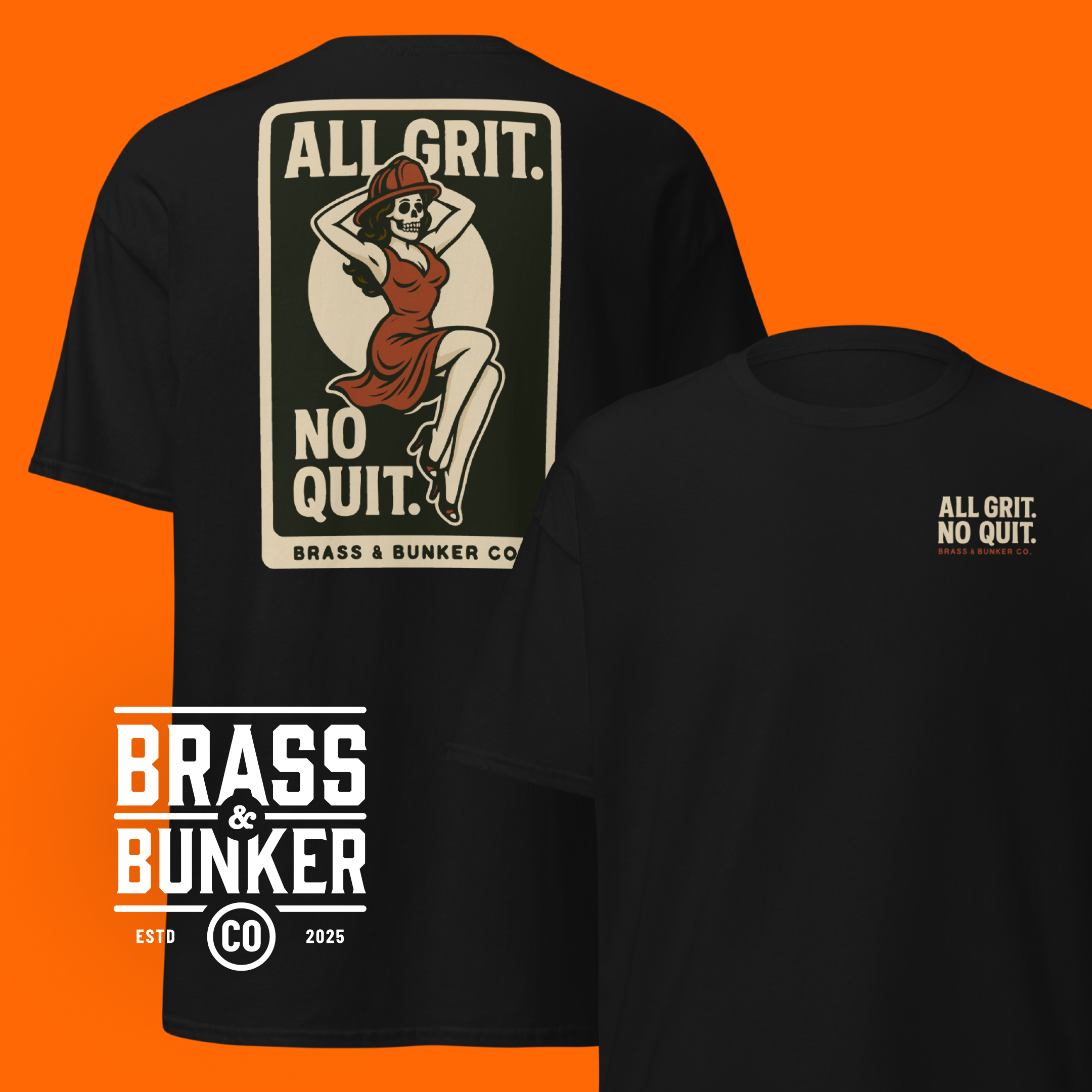
Brass & Bunker Co. A brand built for people who work with their hands, trust what's tested, and don't need to be sold on quality, they can see it.
Brass & Bunker isn't a designer cosplaying as a tough guy. It's a brand built by two brothers, one who's spent a career in military, law enforcement, and emergency services, and one who's spent 25 years designing things that actually work. The street cred belongs to the co-founder. The brand belongs to both of them.
My brother isn't a guy who talks about being tough. He's an ex-military sniper, former police officer, paramedic, and now a firefighter. He's spent his entire adult life in rooms where the gear you're wearing and the tools you're carrying are the difference between a good outcome and a bad one. He has a point of view on quality that can't be faked, borrowed, or manufactured with a marketing budget.
I'm a designer. I've spent 25 years building brands, product systems, and visual identities for founders who needed to go from zero to something real. I know how to take a position and make it legible, how to build the identity, the packaging, the product decisions, and the go-to-market that turn a strong idea into a brand people actually trust.
Brass & Bunker is what happens when those two things work together. He is the credibility. I am the execution. The brand doesn't claim anything he hasn't earned, and that's exactly why it holds up.
The name came from the same place the brand did. Brass because it's honest, no plating, no pretense, just material doing what it says. Bunker because it implies permanence, protection, something built to outlast whatever's coming at it. Together they describe a worldview that one of us has lived and both of us believe in.
"You can't design credibility into a brand. You either have it or you don't. We have it."
Walk into any outdoor retailer or scroll any tactical apparel site and you'll find the same tropes, camo patterns, gear-head copy, imagery of men who look like they've never been anywhere near a real situation. Brands performing toughness for people who want to feel adjacent to it.
Brass & Bunker isn't built for that customer. It's built for people who've actually been there, first responders, military, tradespeople, and the people in their orbit who share the same standard. People who can spot the difference between a brand that earned its position and one that bought a mood board.
The co-founder is the positioning. When a brand is built by someone who has been a sniper, a cop, a paramedic, and a firefighter, that's not a backstory you put in a press release. It's the reason the product decisions are what they are. It's the reason the brand knows what it's talking about.
Most brands in this space are designed for people who want to look the part. Brass & Bunker is built for people who already are. That's a smaller audience. It's the right one, and it's an audience that doesn't forget a brand that got it right.
The design system for Brass & Bunker was built around a single constraint: it has to work in 10 years. That eliminated anything trend-dependent, anything that required explanation, and anything that would look dated the moment the market moved.
The palette leans earth and iron, warm neutrals, deep blacks, the specific warmth of aged brass. Typography is set in faces that have earned trust over decades of use. The mark is built for utility: it stamps, embroiders, debosses, and scales without losing what it is.
Every application, hang tags, packaging, labels, web, was designed from the same visual logic. Not templates applied from a style guide, but a living system where the rules exist to serve the brand promise, not to constrain it.
My brother doesn't tell me what looks good. I don't tell him what's operationally credible. That's the division of labor, and it's why the brand works. He sets the standard. I build the system that communicates it.
When you have a co-founder who has carried a rifle in combat, worked a patrol beat, run calls as a paramedic, and walked into burning buildings, you don't need to manufacture authenticity. The question is just whether the design is good enough to carry it. That's my job.
Every product that comes out of Brass & Bunker goes through both filters: does it hold up by his standard, and does it hold up by mine. If it passes both, it ships. If it doesn't, we go back. That's a slower process than most brands run. It's the right one.
The initial product line is deliberately focused. Not because we can't think bigger, because starting with a tight assortment and getting it exactly right is the only way to build the credibility to expand. Each product earns its place in the line.
Apparel anchors the launch. Not because it's easy, apparel is one of the hardest categories to differentiate in, but because it's the most personal. What you put on your body is a vote for what you believe in. Getting that right establishes the brand standard for everything that comes after it.
The go-to-market strategy for Brass & Bunker is as deliberate as the product design. Direct-to-consumer first, not because it's the easiest path, but because it's the only path that keeps the brand experience intact end-to-end.
Packaging is part of the product. The unboxing experience carries the same design rigor as the product itself, because the moment someone opens a Brass & Bunker package is the first physical moment they have with the brand, and that moment either confirms what they already believed or introduces doubt. There's no room for doubt.
Community comes before scale. The brand is being introduced to a specific audience, people in the design, trade, and craft communities who already have high standards and influence others. Those early customers are the brand's first advocates, and the brand has to earn that advocacy before it can depend on it.
Brass & Bunker is not being built to flip. It's being built to compound. Every product that ships, every brand decision that holds to the standard, every customer who buys and comes back, that's equity that no campaign can manufacture. We're building the brand by doing the work.
I've told a lot of founders to build from conviction, hold the brand standard under pressure, and resist the shortcuts that feel good short-term and cost you everything long-term. Brass & Bunker is the version of that where I'm the founder, my brother is my partner, and there's no client to present to, just the work.
What it demonstrates as a design project: full-stack brand execution, strategy, identity, product development, packaging, e-commerce, and go-to-market, built around a positioning that's real because the people behind it are real. That's the part most brand projects don't have. We do.
Follow the build at brassandbunker.com, or reach out if you want to talk about what it takes to build a brand that actually means something.