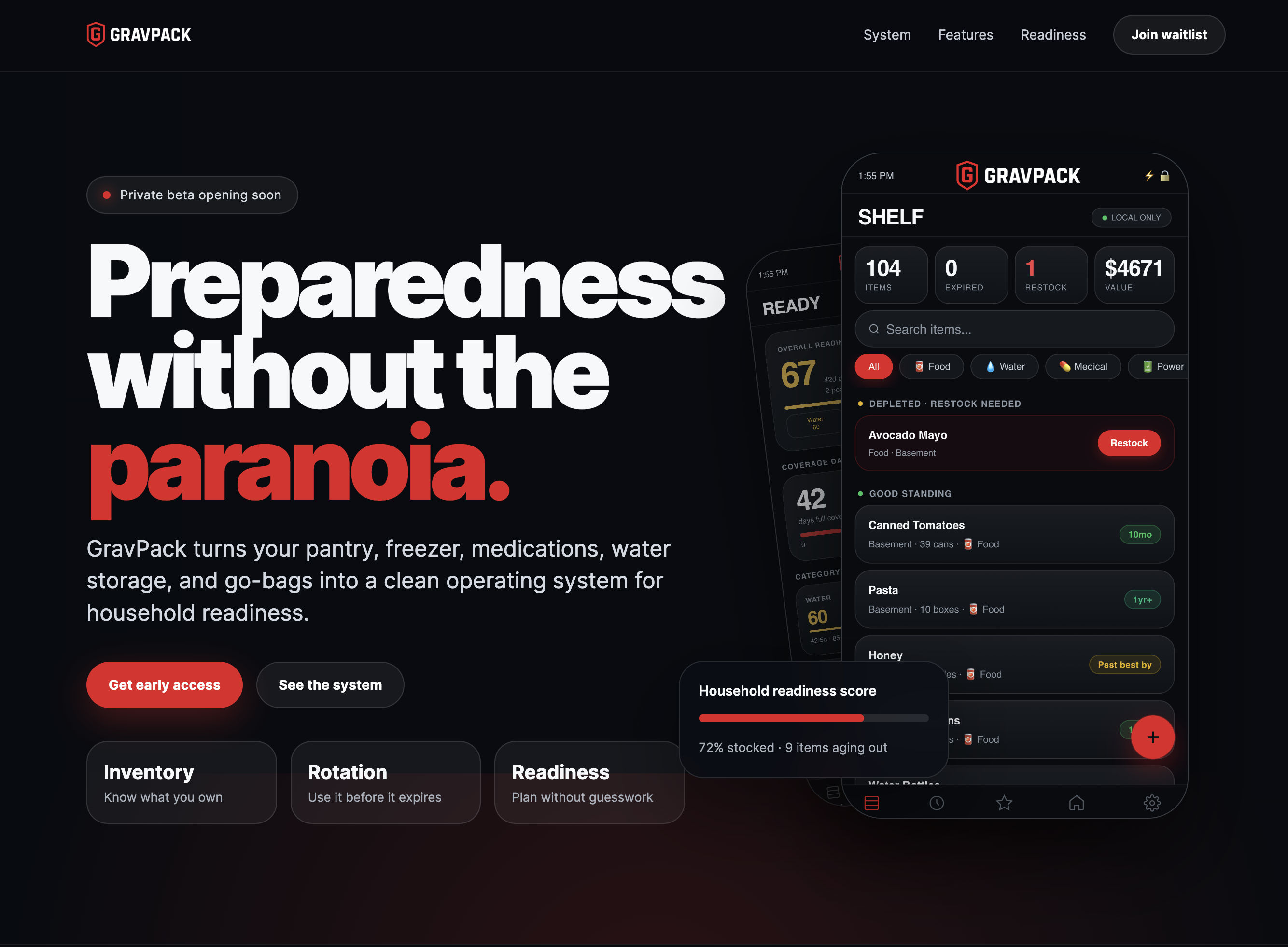
GravPack. Emergency readiness and supply inventory management, built for the millions of people who think they're prepared and aren't.
In 2020, I did what millions of people did, I bought extra. Canned goods, dry storage, supplies. I felt ready. Five years later I opened the pantry and found food years past its best-by date, gaps I hadn't noticed, and no system to tell me any of it. I'm building the app I needed then.
When the world locked down in March 2020, I did what the internet told me to do. I bought extra canned goods. I stocked up on dry storage. I filled the pantry with things that had long shelf lives and felt like I was ahead of something. For a while, I was.
Then five years passed. And when I actually looked at what I had, really looked, not just assumed, I found food well past its best-by date, categories I thought I'd covered but hadn't, and zero visibility into what was actually usable versus what I'd been storing out of habit. I thought I was prepared. I wasn't. I just owned expired food.
The problem isn't that people don't care about preparedness. The problem is that preparedness has no feedback loop. You buy stuff, you put it somewhere, and you assume it's there and valid until it isn't, usually at the exact moment you need it. GravPack exists to close that loop.
"Preparedness isn't a purchase. It's a system. And most people have the purchase, not the system."
There are apps for grocery lists. Apps for pantry management. Apps for budgeting your emergency fund. But there is no app that looks at your full preparedness picture, what you have, when it expires, what category you're weak in, and what you should do about it, and gives you an honest readout.
Most people who consider themselves prepared are operating on assumptions that are months or years out of date. They bought things, filed them mentally as "done," and moved on. The reality is that preparedness is a living system with expiration dates, rotation schedules, and category gaps that only surface when you need them to not be there.
The gap isn't awareness, most people know they should be prepared. The gap is visibility. Nobody knows what they actually have, when it expires, or where their real weaknesses are. GravPack makes the invisible visible.
GravPack is built around a simple premise: your preparedness level should be something you can see, not something you have to figure out. The app manages your supply inventory, tracks expiration dates, surfaces gaps by category, and tells you what to do about them, in plain language, without a survival manual.
The design is intentionally approachable. This isn't for the tactical community, it's for the person who bought extra stuff in 2020 and wants to actually know if it's still good. The interface should feel like a smart pantry manager, not a military logistics system.
Preparedness apps fail because they design for the anxiety that motivates someone to download, and then the anxiety fades. Life goes back to normal, the app sits unused, and two years later the person who downloaded it has the same problem they started with.
GravPack is designed for the calm period between the anxiety and the next event, because that's when you have time to actually build a system. The UX has to make inventory management feel light enough to do when nothing is wrong, so it's actually useful when something is.
That means fast entry, visible progress, and a feedback loop that makes you feel better, not more anxious. The readiness score goes up as you build. That feels good. That's the behavior design that keeps people engaged after the emergency has passed.
The addressable market for GravPack isn't the prepper community, it's the vastly larger group of people who had a genuine preparedness moment in 2020, did something about it, and then slowly let that effort decay without realizing it.
That's tens of millions of people in the US alone. People who have stuff in a closet somewhere, who feel like they've handled it, but who couldn't tell you with confidence what they have, if it's still good, or what they're missing. They don't want to become survivalists. They just want to actually be prepared.
GravPack is a zero-to-one build, architecture, UX, visual design, and App Store launch, built by a designer doing the full job. No team, no agency, no handoff. The constraint isn't a limitation. It's the thing that keeps the product coherent.
What I'm building at GravPack demonstrates the same thing I've demonstrated across 25 years of client work: finding the real problem underneath the obvious one, designing a system that changes behavior rather than just adding features, and executing with enough craft that the product earns trust on first use.
Follow the build at gravpack.com, or check your pantry. There's a good chance something in there expired two years ago.