Orderful · Head of Product Design · 2021–2025

From 90 Days to 9:
How Redesigning EDI
Onboarding Scaled
Orderful to $10M ARR

Four years building the design function from scratch at a Series A/B EDI infrastructure company — and unlocking an entirely new market by putting enterprise-grade tools in the hands of small businesses that had never touched EDI before.

90%
Reduction in time-to-revenue
90 days → 9 days
$10M+
ARR at exit
from under $1M at start
20+
New market segment
WebEDI users unlocked
Role
Head of Product Design
Tenure
2021–2025 (4 years)
Team
Sole design lead + freelancers
Scope
Full product — 0 to platform

The Hook

A small golf startup just won a Kohl's deal. They had no EDI infrastructure.

Electronic Data Interchange — EDI — is the invisible infrastructure of retail. Every major retailer, from Walmart to Kohl's to Target, requires it. It governs how purchase orders, invoices, ship notices, and acknowledgments flow between trading partners. It is, by design, impenetrable to anyone who isn't a specialist.

When a small golf retail startup won a contract with Kohl's, they hit the wall every growing vendor hits: to fulfill the order, they needed to be EDI compliant. That typically meant a 90-day professional services engagement, a specialist team, and infrastructure that most small businesses couldn't afford or staff. They had days, not months. And they had no EDI team.

The insight

The problem wasn't that EDI was technically hard. The problem was that every tool built for EDI was designed for specialists, not for the businesses that actually needed to use it. WebEDI was the answer: a guided document creation tool that let any vendor achieve EDI compliance in minutes, with no prior knowledge required.

This is the case study of how we rebuilt Orderful's onboarding from a 90-day professional services engagement into a self-serve platform that any business could navigate — and how WebEDI opened the door to a market that traditional EDI infrastructure had always locked out.

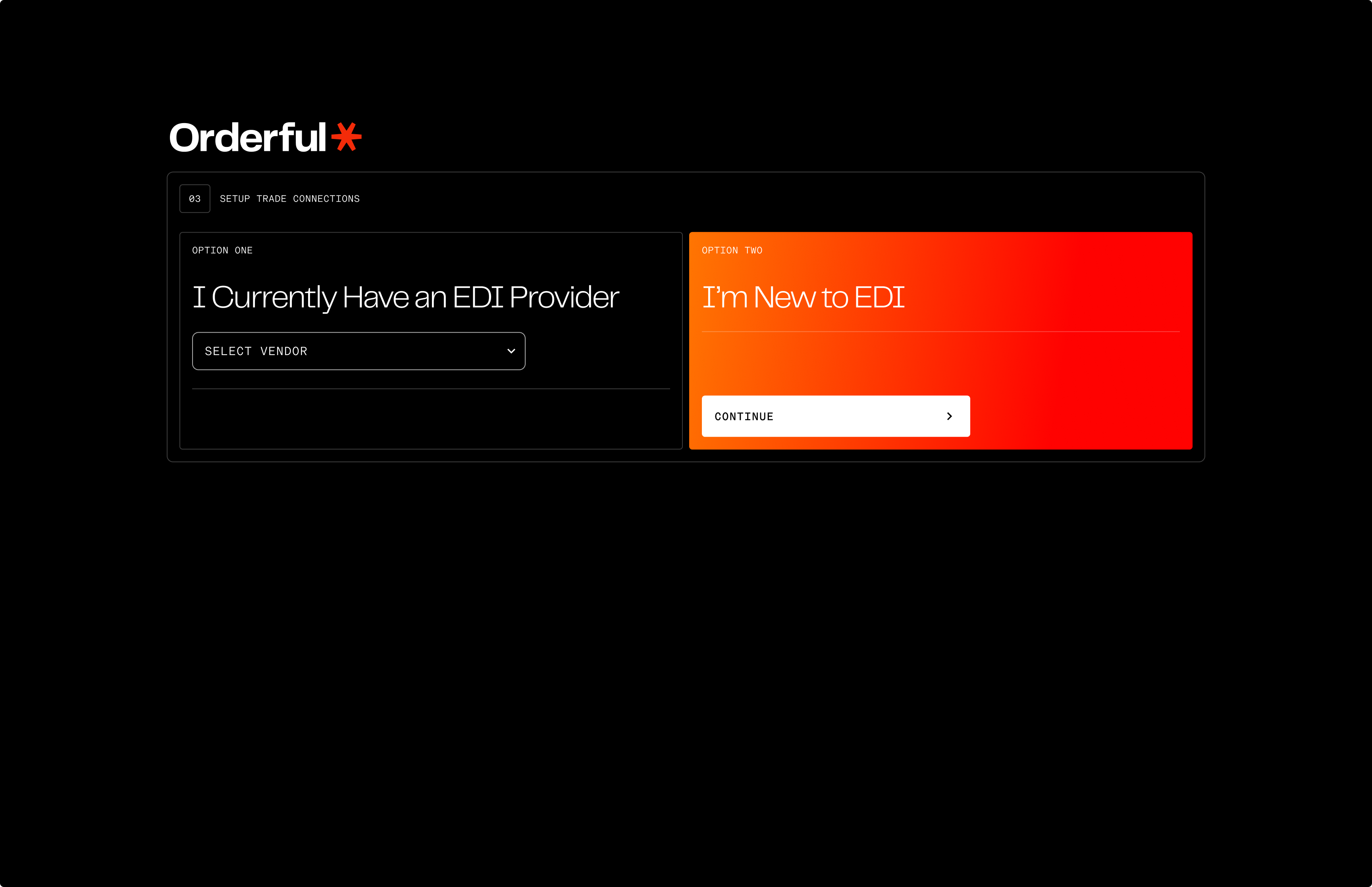
Orderful onboarding Step 03 — I Currently Have an EDI Provider vs I'm New to EDI
Onboarding Step 03 — Setup Trade Connections. The binary split-path that routes users based on their EDI context. "I'm New to EDI" is the WebEDI entry point — the design decision that unlocked the new market segment entirely.

The Problem

EDI was a specialist domain. Orderful was going to change that.

When I joined Orderful in 2021, the company had a compelling vision — modernize EDI with an API-first platform — and a product that reflected where it had come from: a tool built by EDI engineers for EDI engineers. Onboarding required deep technical knowledge. Configuration meant navigating ISA IDs, X12 transaction sets, VAN credentials, and communication channels that most users had never heard of.

The result: time-to-revenue averaged roughly 90 days. Getting a new trading partner live meant a guided professional services engagement, extensive back-and-forth between teams, and a setup process that required Orderful staff at every step. That wasn't scalable — and it was a ceiling on growth.

There was also a market the product simply couldn't reach: small and mid-size vendors who needed EDI compliance to sell through major retailers, but had no technical team to implement it. The golf startup. The boutique apparel brand. The emerging food company that just landed its first Target order. They were being locked out.


Design Strategy

Four principles that guided every decision.

Before touching wireframes, I needed to understand why onboarding was slow. It wasn't that users were incapable — it was that the product asked them to make decisions they didn't have the context to make. Every ambiguous field, every open configuration choice, every moment where the product said "configure this" instead of "here's the answer" added friction and delay.

01
Self-serve over professional services
Every step that required Orderful staff involvement was a step we could eliminate with better design. The goal was for customers to go live without needing us in the room.
02
Certified guidelines over open configuration
Trading partner requirements are knowable. Instead of asking users to figure them out, we baked certified guidelines directly into the setup flow — removing ambiguity at the point of decision.
03
Automate what customers shouldn't think about
Repetitive, predictable steps — gathering EDI specs, delivering requirements, routing trade requests — should happen automatically. Customers should only touch what requires their actual input.
04
Route by context, not by product tier
A vendor new to EDI and an enterprise already running X12 need completely different paths. The platform needed to detect context early and route users to the right experience — not force everyone through the same technical setup.

The Work — Signup & Account Creation

A guided wizard that sets the stage before users ever reach the platform.

The signup flow is deceptively simple. Four steps: create account, set up profile, configure trade connections, select a plan. But each step does more than collect information — it qualifies, routes, and prepares users for what comes next.

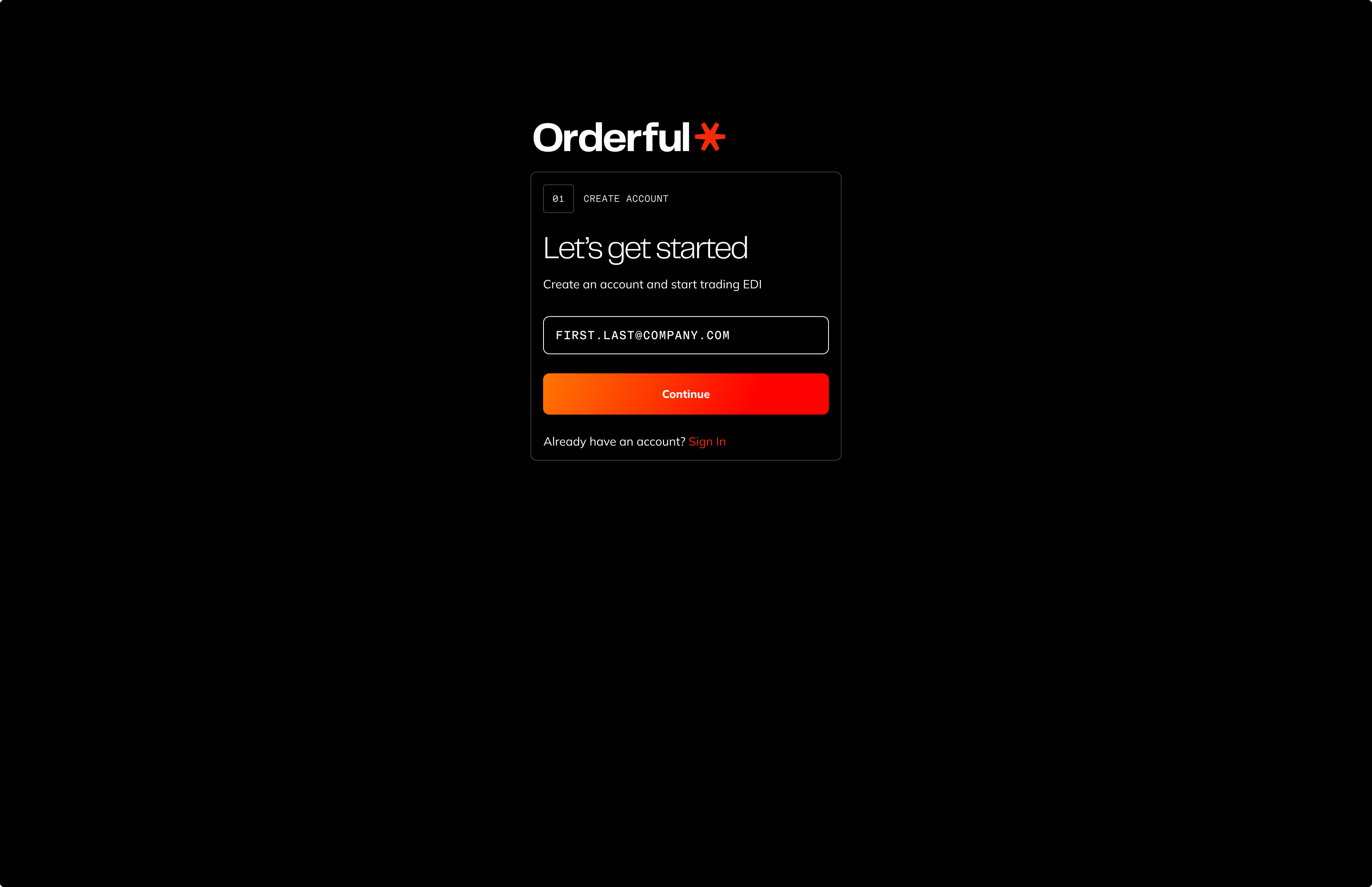
Orderful Step 01 — Let's get started, desktop
Desktop — Step 01. Create account entry point. Clean, focused, zero distraction.
Orderful Step 01 — Let's get started, mobile
Mobile. Fully responsive signup — same guided wizard, smaller canvas.

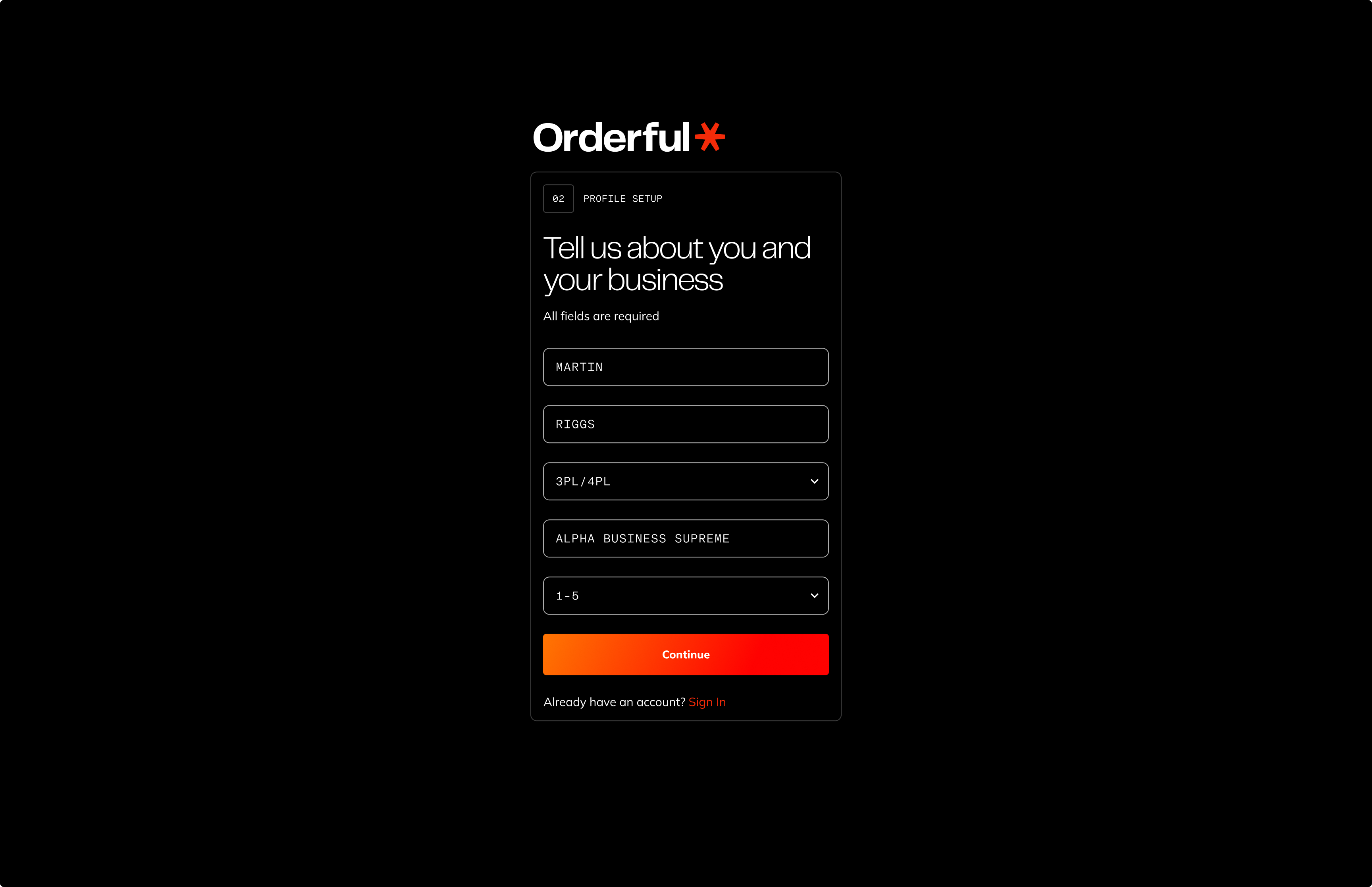
Step 02 collects business context — business type, public name, and critically, number of trading partners. That last field isn't just data collection. It's the first signal we use to route users toward the right plan and experience. A company with 200 trading partners needs a fundamentally different setup than one connecting to their first retailer.

Orderful Step 02 — Tell us about your business
Step 02 — Profile Setup. Email verified confirmation, business context fields, and trading partner count — all working together to personalize the path forward.

Step 03 is the pivotal split: "I Currently Have an EDI Provider" vs. "I'm New to EDI." This single design decision opened the WebEDI market. Existing users get a migration path. New users get a guided, no-expertise-required experience. The platform stops trying to be one thing for everyone.

The Work — Onboarding Transformation

The six-step guided setup that cut time-to-revenue by 90%.

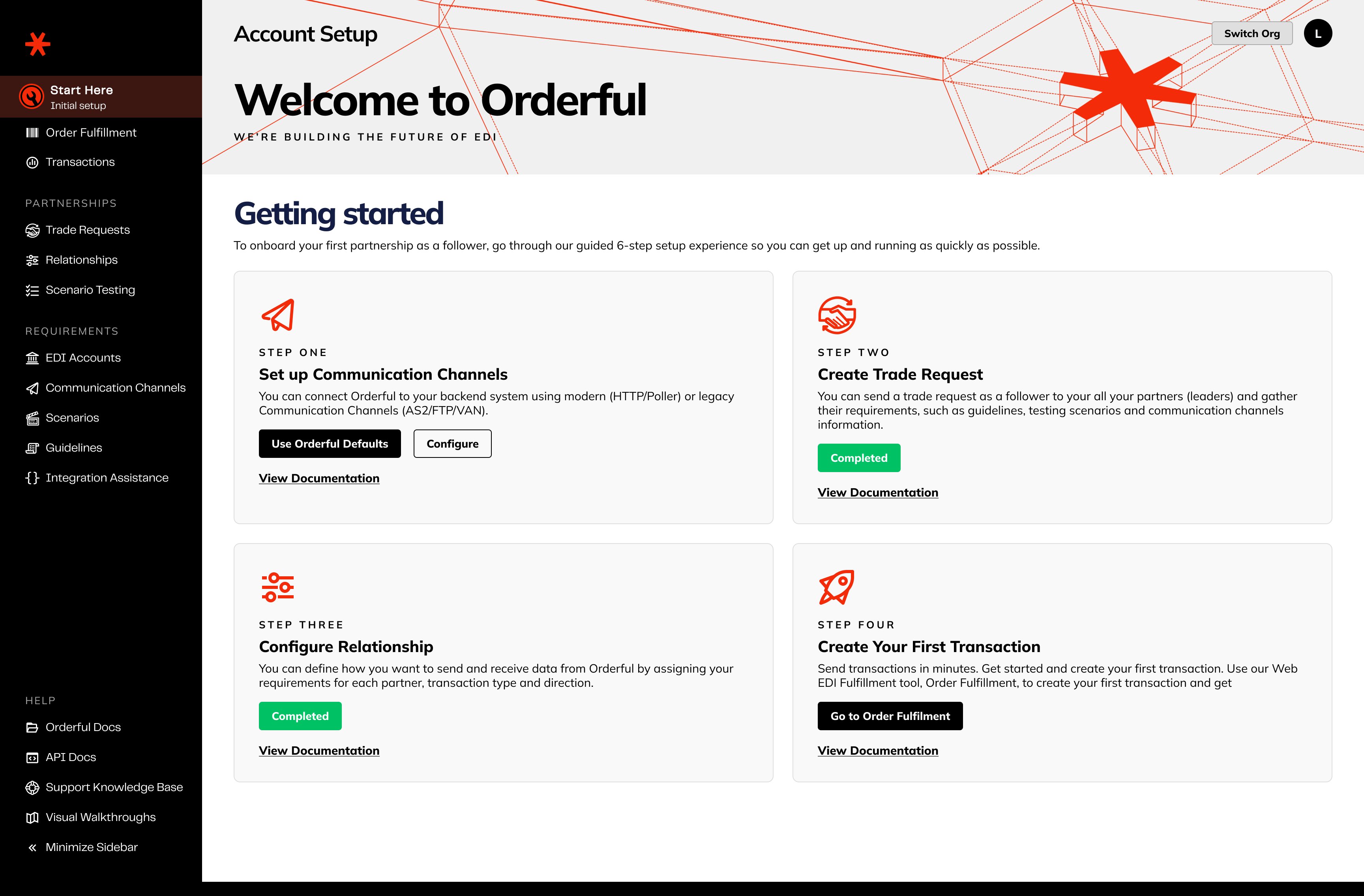
The core of the onboarding transformation was the post-signup account setup experience: a six-step guided checklist that walked users from zero to their first live transaction. Each step had a default path — "Use Orderful Defaults" — for users who didn't need to customize, and a configure path for those who did. Progress was tracked visibly. Documentation was linked contextually. Nothing required a support ticket.

01
Set up Communication Channels Default available
Connect to backend systems via HTTP/Poller or legacy AS2/FTP/VAN. Most users could accept Orderful defaults in one click — no configuration needed.
02
Create Trade Request
Send a trade request to trading partners, gathering their requirements automatically. Previously a manual, multi-day back-and-forth. Now a guided, automated workflow.
03
Configure Relationship Completed
Define how data flows between trading partners — transaction types, directions, requirements. Certified guidelines reduce ambiguous configuration decisions to a series of clear choices.
04
Create Your First Transaction
Send transactions in minutes using Order Fulfillment — the WebEDI tool. For new-to-EDI users, this is the moment the platform proves its value: a real EDI document, sent successfully, with no specialist required.
Welcome to Orderful — 6-step guided setup
Account Setup — the guided 6-step experience. Step completion tracked visibly. "Use Orderful Defaults" reduces friction for the majority of users. Documentation linked at every step for those who need context.

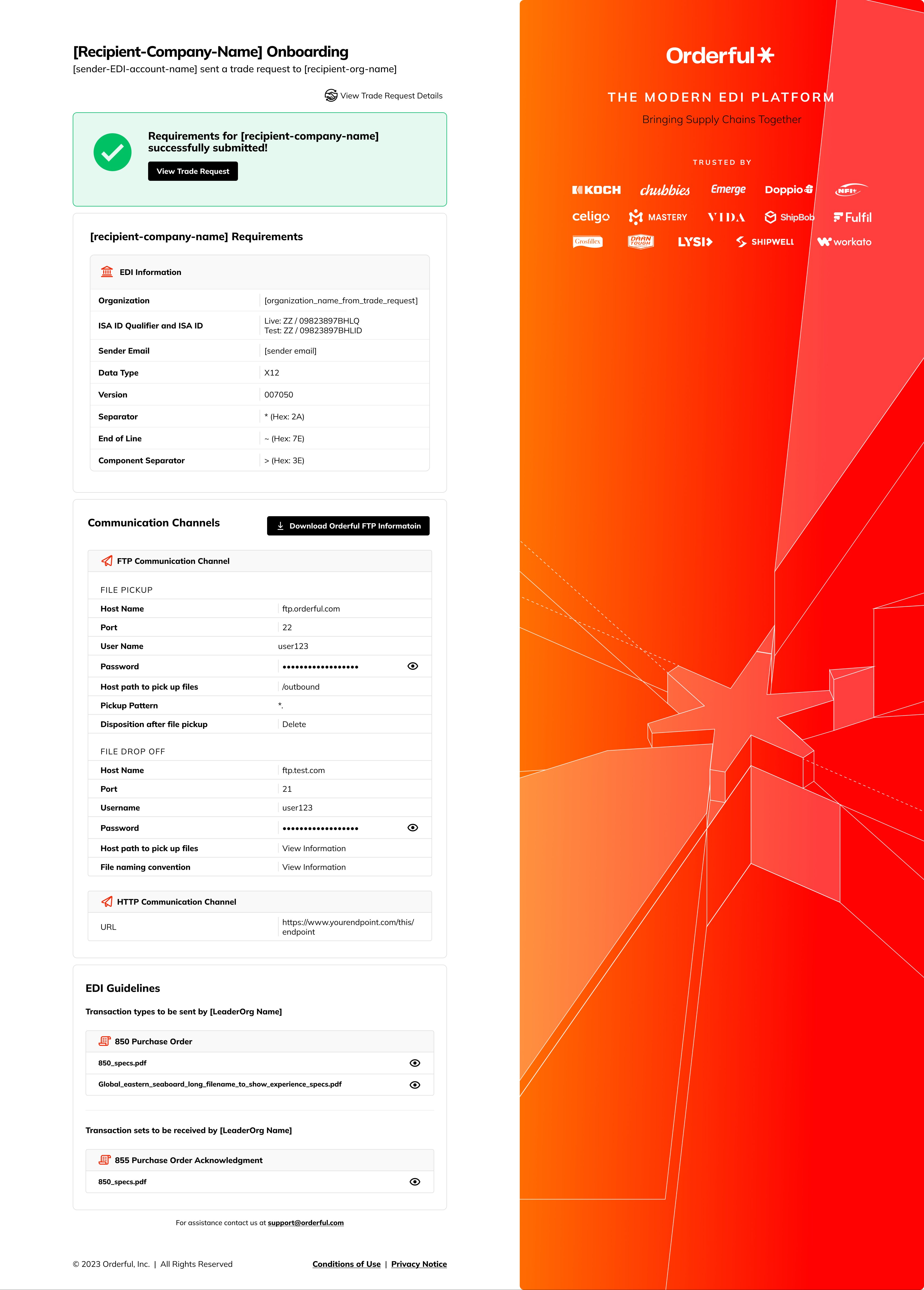
One of the highest-leverage decisions was automating the trade request delivery. Previously, a follower (vendor) joining the platform had to manually gather their trading partner's EDI requirements — ISA IDs, communication channel details, transaction specs. We automated this entirely: when a trade request is created, all requirements are packaged and delivered automatically to the recipient, pre-populated and structured.

TR Automation — automated trade request delivery
Automated trade request delivery. All EDI requirements — ISA IDs, communication channels, transaction specs, EDI guidelines — delivered automatically to the recipient. What used to take days of back-and-forth now happens in one click.

The Work — Trading Partner Management

Managing hundreds of relationships at enterprise scale.

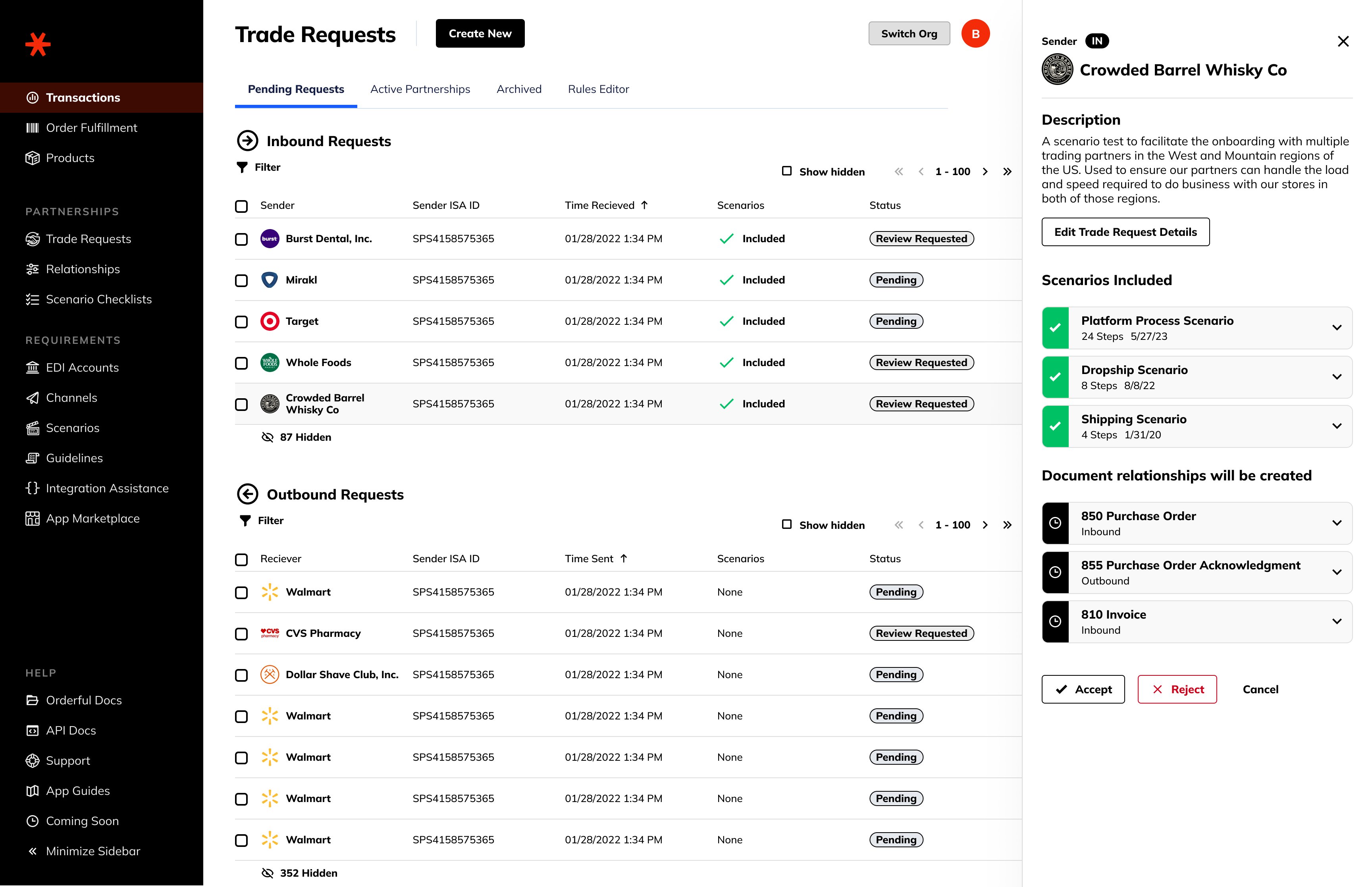
As customers scaled on the platform, they needed to manage not one trading partner but dozens — sometimes hundreds. The Trade Requests interface gave them full visibility across inbound and outbound requests, with scenario checklists, document relationship maps, and status tracking all accessible from a single view.

Trade Requests — sidepanel with scenarios
Trade Requests — platform view. Inbound and outbound requests across all trading partners. The sidepanel surfaces scenarios, document relationships (850 PO → 855 Acknowledgment → 810 Invoice), and accept/reject controls — without leaving the list view.

The Create Trade Request flow embedded the "Leader vs. Follower" model — a core Orderful concept — into a guided modal that non-technical users could navigate without understanding the underlying EDI architecture. Search by company name, select your role, and the platform handles the rest.
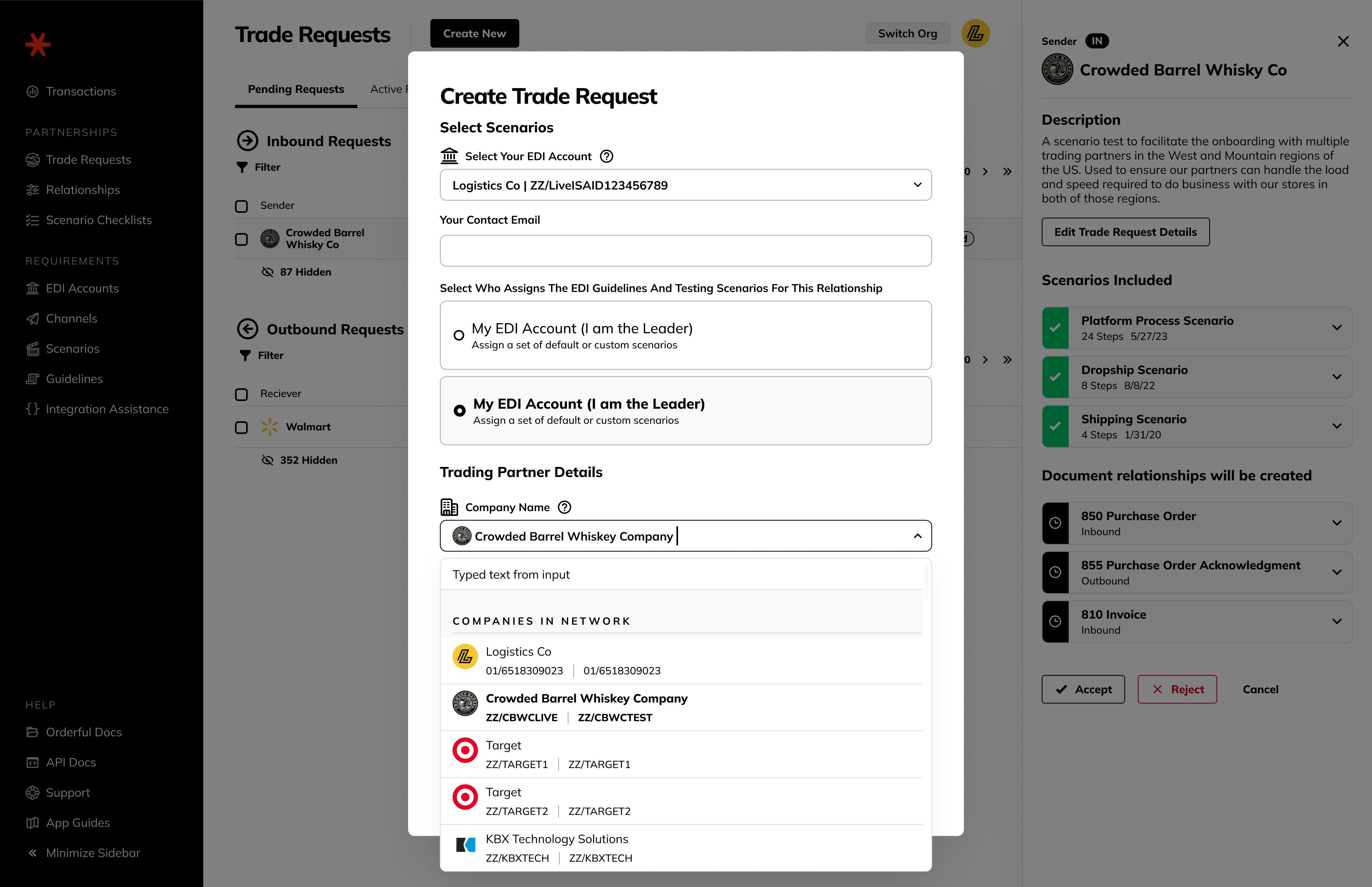
Create Trade Request modal — company search with ISA IDs
Create Trade Request. Guided Leader/Follower routing, company network search with ISA IDs surfaced, and scenario selection — all in a single modal. The complexity of EDI relationship setup, made approachable.

The Work — WebEDI & Order Fulfillment

The golf startup goes live with Kohl's. In days, not months.

WebEDI — Order Fulfillment — is the tool that made the Kohl's deal possible. A guided interface for creating EDI transactions without technical knowledge. A vendor receives a purchase order from a retailer, fulfills it step by step, and sends back the required documents — 855 acknowledgment, 856 ship notice, 810 invoice — without writing a line of code or understanding X12 transaction sets.

The plan selection screen reflects the design thinking: WebEDI is positioned as the entry point for any business just getting started with EDI. "Up and running in minutes. No integration required." That's not marketing copy — it's a design promise we built the entire tool to keep.

Liquid Death — Derek Wu testimonial and WebEDI metrics
Liquid Death — Derek Wu, Business Applications Manager. 80% reduction in time to set up trading partnerships. 4X faster to go live than competitors. 90% faster error resolution. 100% visibility and control of their EDI environment. Real outcomes from a real WebEDI customer.
"With Orderful, we have visibility and control over our EDI. It's great to finally own the keys to the kingdom and not rely on outside parties."
Derek Wu — Business Applications Manager, Liquid Death
80%
Reduction in time to set up trading partnerships
Faster to go live than competitors
90%
Faster error resolution

The Order Fulfillment interface shows the platform at scale: 1,109 orders active, 550 completed. Purchase orders from Walmart. Workflow status tracked across every transaction step. Validation errors surfaced inline with clear remediation paths. For a small vendor, this was infrastructure they could never have built themselves — delivered through a web interface they could use on day one.
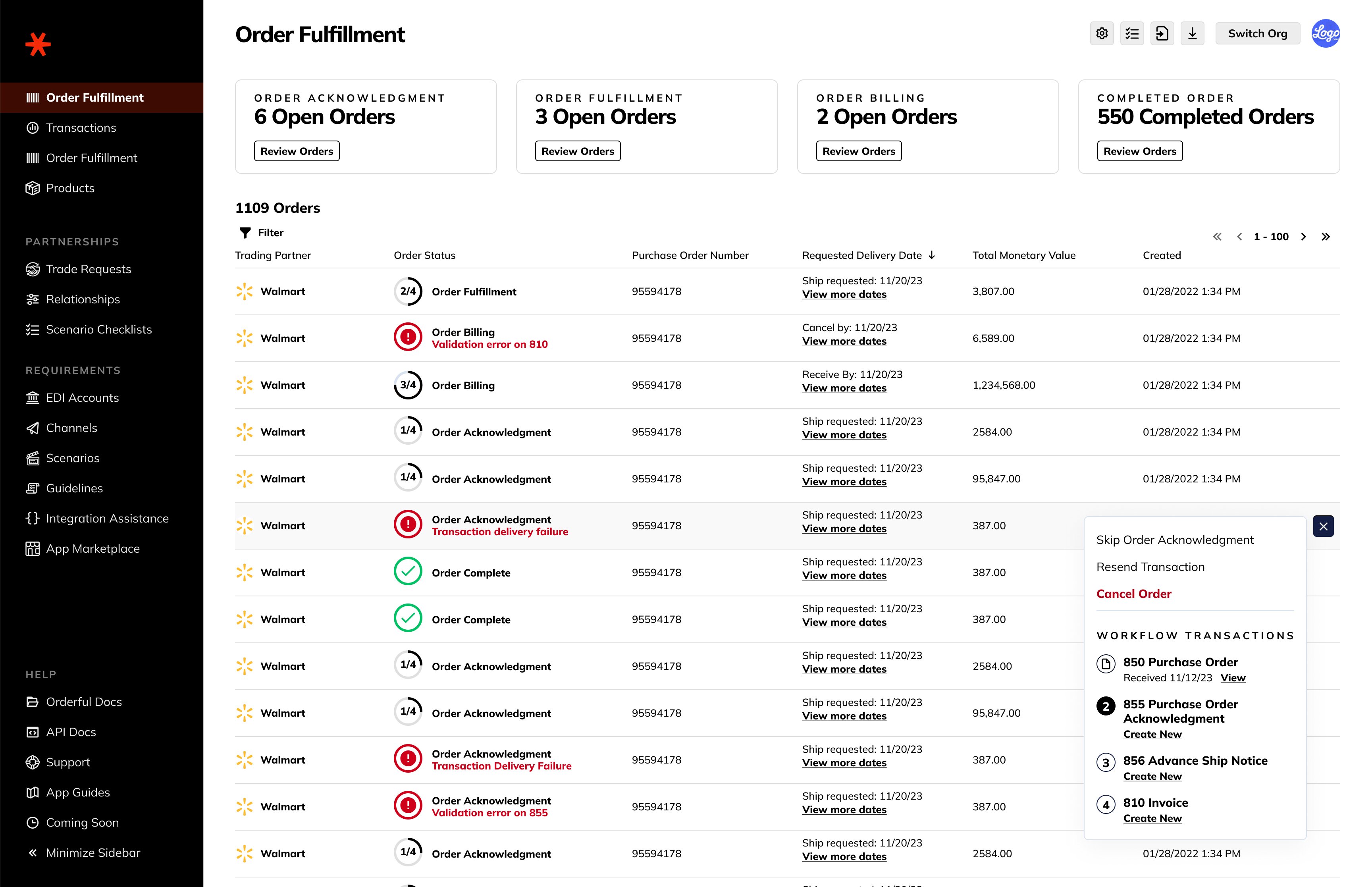
Order Fulfillment — 1109 orders at scale
Order Fulfillment — platform at scale. 1,109 live orders. Workflow status tracked across every step (850 → 855 → 856 → 810). Validation errors flagged inline. A small vendor, transacting with Walmart, with full EDI compliance — through a tool they learned in an afternoon.

The 856 Advance Ship Notice screen is WebEDI in its most detailed form: a structured, guided document creation interface that walks a vendor through shipping details, item quantities, package information, and transaction references. Every field is labeled. Every section is collapsible. The workflow status bar at the bottom tracks where this document sits in the broader order lifecycle.
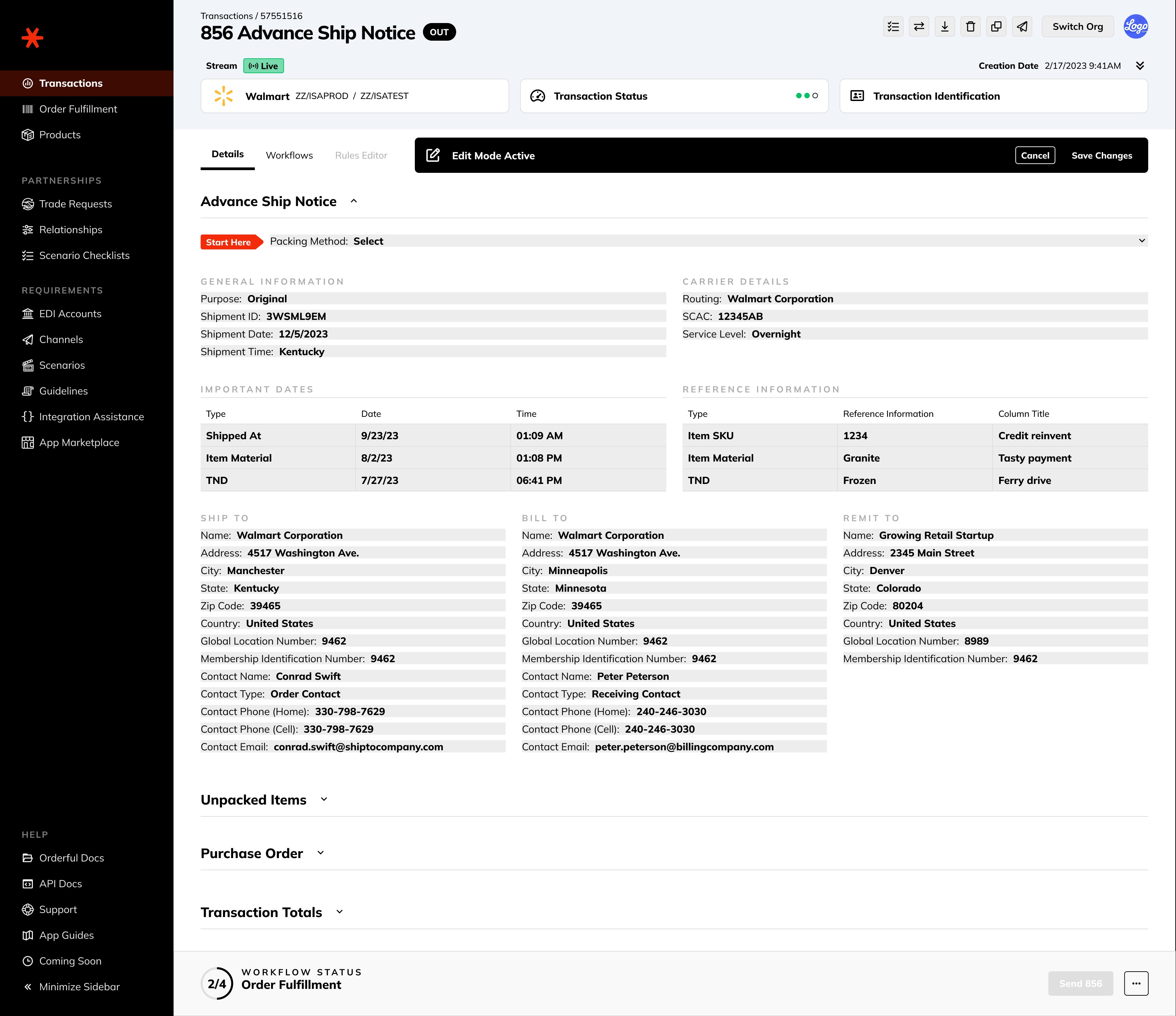
856 Advance Ship Notice — WebEDI document creation
856 Advance Ship Notice — WebEDI document creation. Guided fields, structured sections, item-level detail. A transaction that once required a specialist and weeks of setup, completed by a small vendor in minutes.

Outcomes

Four years. A platform built from zero. A market unlocked.

When I joined Orderful, the design function didn't exist. I built it from scratch — the systems, the process, the cross-functional rhythms, the freelance team that expanded and contracted with the product's needs. The goal was always to make the design function invisible in the best sense: to produce a product so clear and so well-considered that onboarding felt effortless, and growth felt inevitable.

90%
Reduction in time-to-revenue. 90-day professional services engagement compressed to 9 days of self-serve onboarding.
$10M+
ARR at exit. Orderful scaled from under $1M to $10M+ ARR during my tenure — onboarding and activation were the primary growth lever.
New market
WebEDI unlocked a market traditional EDI infrastructure couldn't serve: small and mid-size vendors needing retail compliance with no technical team.
0 → platform
Built the design function from zero: design system, component library, research practice, cross-functional process, and a freelance team managed throughout.
View all work
Back to portfolio
View all case studies →