DAT Freight & Analytics · Lead Product Designer · 2020–2021

Building the Freight
Industry's First
Intelligence Platform
from Zero

Joined as a founding team member to design DAT iQ from the ground up — a modular, real-time freight analytics platform that consolidated five legacy tools into a single intelligence layer, and secured millions in executive budget through a multi-year product vision.

0→1
Zero-to-one platform build
Founding design team member
5→1
Legacy tools consolidated
into unified intelligence layer
$MM
Budget secured via
multi-year design vision
Role
Lead Product Designer
Timeline
Q4 2020 – Q3 2021
Team
Founding team, hired first senior designer
Scope
Platform vision + full product design
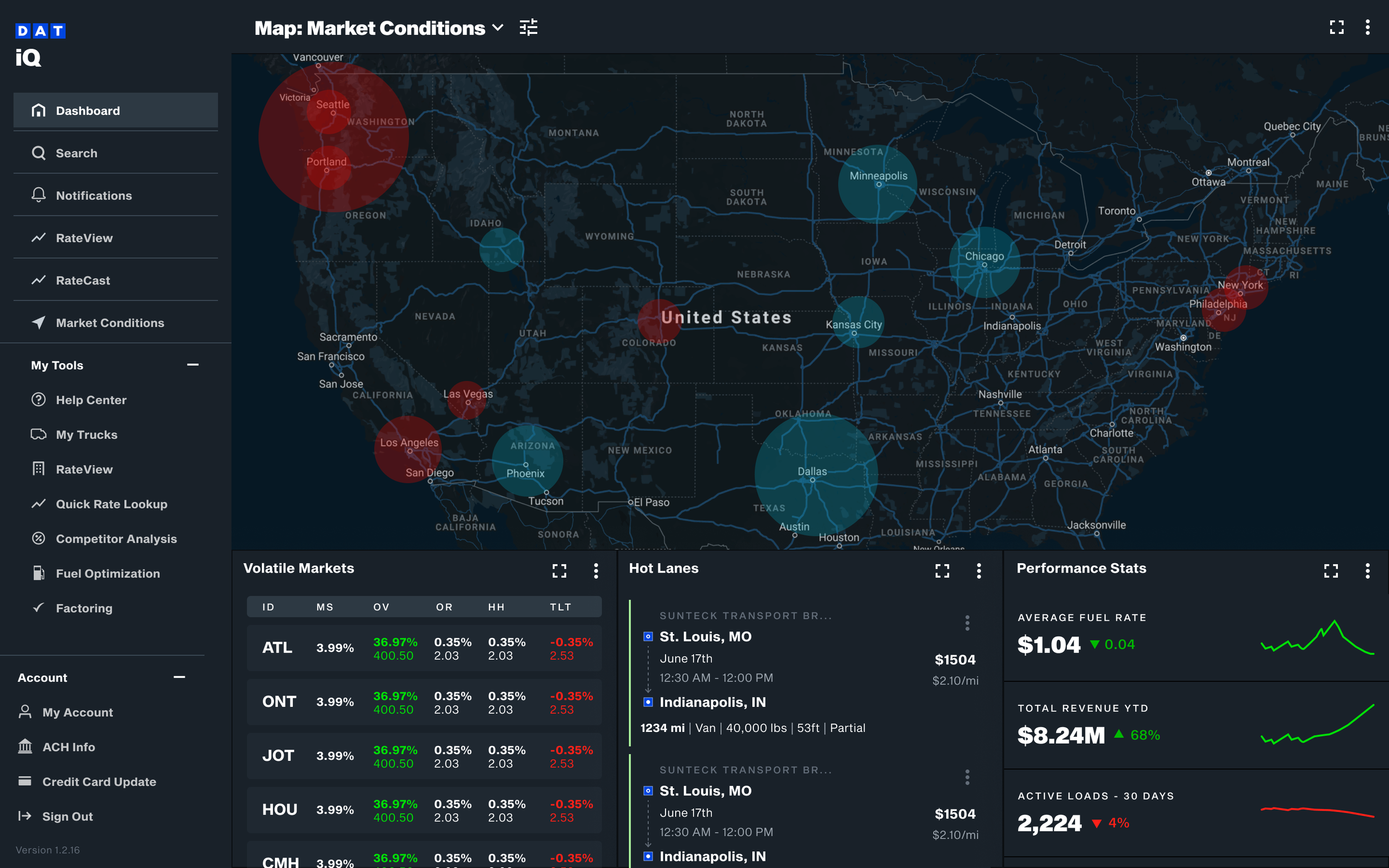
DAT iQ freight intelligence platform — lane rates and map view
DAT iQ — Freight Intelligence Platform. Rates, lanes, market conditions, and forecasts unified in a single configurable interface. Built from zero over nine months as a founding design team member.

The Problem

The freight market was more volatile than ever. The tools to navigate it were scattered, siloed, and built for a different era.

In late 2020, DAT Freight & Analytics had a data advantage that most freight technology companies could only aspire to — decades of rate history, real-time load board data, and market intelligence that carriers and brokers relied on daily. What they didn't have was a platform that made any of that data actionable at the speed the market required.

Five legacy products — Rateview, Ratecast, FMIC, MCI, and Lanemakers — each did something useful in isolation. None of them talked to each other. None of them offered the kind of integrated, configurable intelligence that a modern brokerage needed to navigate volatile markets, make pricing decisions, and plan capacity weeks ahead.

The brief

Design DAT iQ from the ground up — a modular, real-time, data-driven platform that serves as a strategic business intelligence tool, delivering custom analytics, forecasts, and recommendations. Build not just the product, but the multi-year vision to secure the budget to build it.

I joined as part of the founding team, responsible for the full design — concept to high-fidelity — and for building a vision compelling enough to unlock significant executive investment. Within nine months, we delivered both.


Goals

Three layers of success: business, product, and design.

Before any wireframes, we aligned on what success looked like across three dimensions. These weren't decorative goal-setting — they became the filter for every design decision and the framework for the executive pitch that secured the platform's budget.

Business Goals
  • Maintain and drive scalable revenue growth
  • Drive business intelligence across the enterprise
  • Become the industry standard for freight analytics
  • Identify and unlock emerging lines of business
Product Goals
  • Seamless integration with DAT One's tactical layer
  • Increase user growth by lowering product walls
  • Feature parity with Sonar to reclaim market share
  • Reduce gatekeepers and improve scalability
  • Establish delivery timelines with measurable KPIs
Design Goals
  • Service core interactions for brokers, shippers, and carriers
  • Data-informed design decisions throughout
  • Deliver experiences that let users learn, evaluate, and act
  • Customizable data sets via subscriptions and add-ons
Platform Positioning
  • DAT iQ — strategic tooling for business intelligence
  • DAT One — tactical tooling for daily freight transactions
  • Together: a complete platform for short- and long-term decisions
  • Modular by design — expandable beyond freight

Platform Architecture

Two toolkits. One platform. Clear separation of strategic and tactical work.

The most important framing decision we made early was defining what DAT iQ was not. It wasn't a replacement for DAT One — Orderful's tactical load board and daily transaction tool. It was the intelligence layer above it: a strategic toolkit that gave brokers, shippers, and carriers the context to make better decisions before, during, and after their daily operations.

DAT iQ — Strategic Layer
Analytics, Forecasts & Recommendations
Visualization, analysis, automation, and forecasting tools for short- and long-term business intelligence. Customers use iQ to advance their freight strategy and strengthen their position in volatile markets.
DAT One — Tactical Layer
Matching, Tracking & Daily Transactions
The load board and transactional engagement layer. Matching, factoring, monitoring, and daily operational tools. Customers use One to find and engage in daily freight business through intelligent matching.

Multi-Year Product Vision

Three stages. A realistic path from SLC to platform scale.

One of the most consequential deliverables wasn't a screen — it was the multi-year roadmap that secured executive buy-in and unlocked the budget to build the platform. We defined three progressive stages that balanced near-term delivery with long-term ambition: a Smallest Lovable Core that consolidated existing tools, a Growth phase that introduced marketplace infrastructure, and a Scale phase that flipped the model inside-out by letting customers build on the platform.

Stage 01 — SLC
DAT iQ v1.0
  • Consolidate Rateview, Ratecast, FMIC, MCI, Lanemakers
  • Custom dashboards with filtering and personalization
  • Lane management — single and bulk upload
  • Shareable quote and RFP pricing data
  • Optimized short- and long-term pricing views
Stage 02 — Growth
DAT iQ Growth
  • Marketplace — product catalog, featured content, betas
  • My Tools — optimization, automation, analysis
  • Micro and macro automation tooling
  • Revenue and performance analysis views
  • Waitlists and product ramp mechanisms
Stage 03 — Scale
DAT iQ Scale
  • Self-service APIs for data-sophisticated customers
  • Tool builders — customers build on the platform
  • SDKs and external vendor marketplace contributions
  • Self-service integrations via DAT Platform connections
  • "Inside-out" product development ethos
Executive impact

The three-stage vision — presented directly to DAT leadership — was the design artifact that secured millions of dollars in platform development budget. Outlining a clear strategic roadmap demonstrated that DAT iQ wasn't a one-off product, but a long-term platform investment with compounding returns.


Information Architecture

Mapping the platform before the first pixel.

With five legacy tools to consolidate and a three-stage vision to architect, the IA work was as much strategic as it was structural. The high-level IA map defined how existing DAT data products would map to the new platform's navigation — dashboards, rates, lanes, notifications, tools, account, and analytics — and color-coded each node against the v1.0, Growth, and Scale delivery phases.
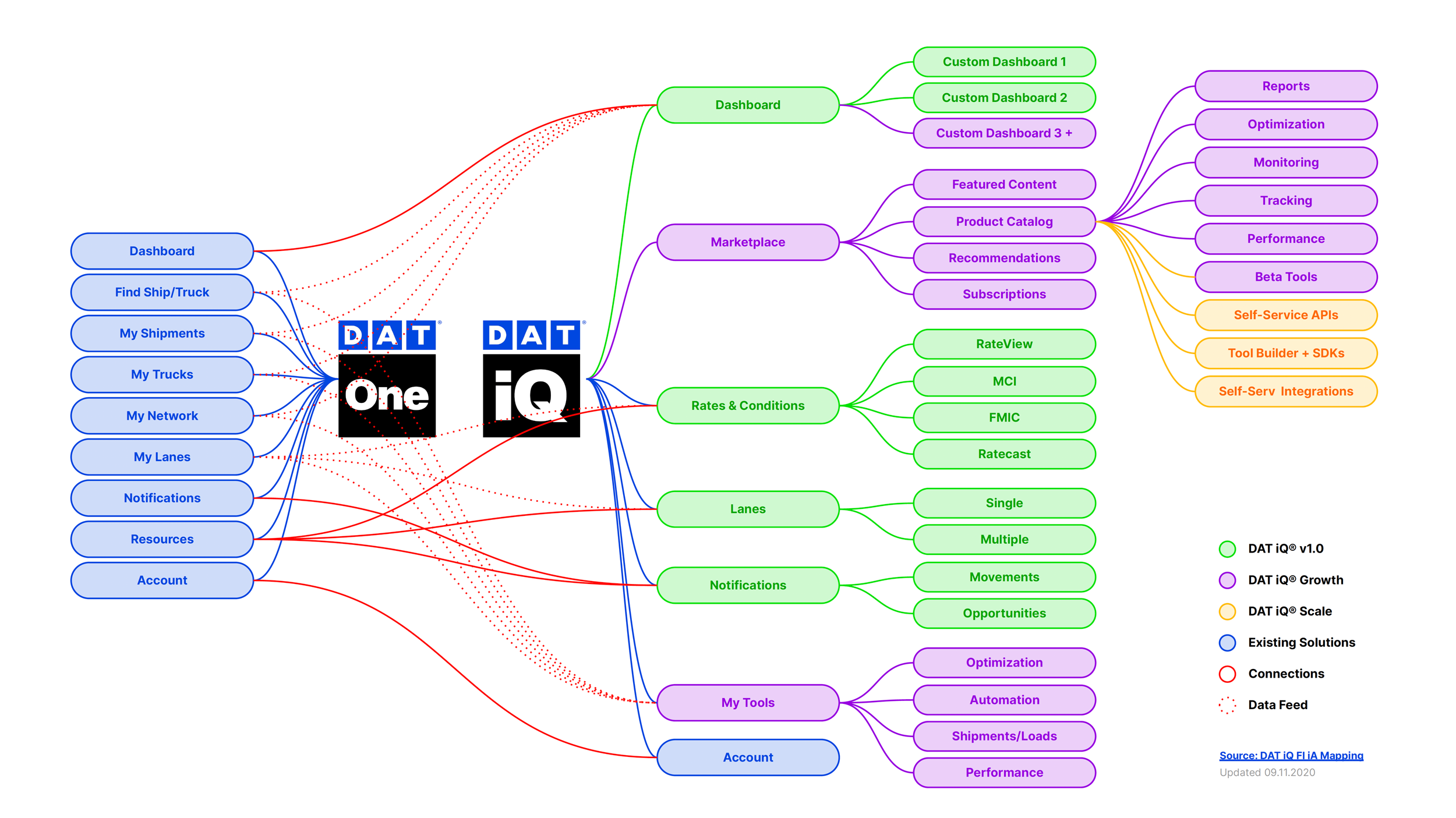
DAT iQ high-level information architecture mapping
High-level IA map. Color-coded by delivery phase — v1.0, Growth, and Scale — across dashboard, rates, lanes, notifications, tools, account, and analytics. The map that turned a five-product consolidation into a coherent platform architecture.

Design Approach

Modular and configurable — built for a wide range of use cases from day one.

The freight industry isn't monolithic. A carrier planning capacity three months out needs different tools than a broker quoting a spot rate this afternoon. The design system for DAT iQ was built around a core principle of flexibility: modular widgets and configurable dashboards that users could arrange around their specific workflows, without sacrificing depth or analytical power.

Both light and dark themes were designed from the outset — dark for data-dense analytical views, light for lane management and operational contexts. The result was a platform that adapted to the environment and task at hand, rather than imposing a single visual mode on every user interaction.

Early Concepts

Sketching the dashboard structure before committing to fidelity.

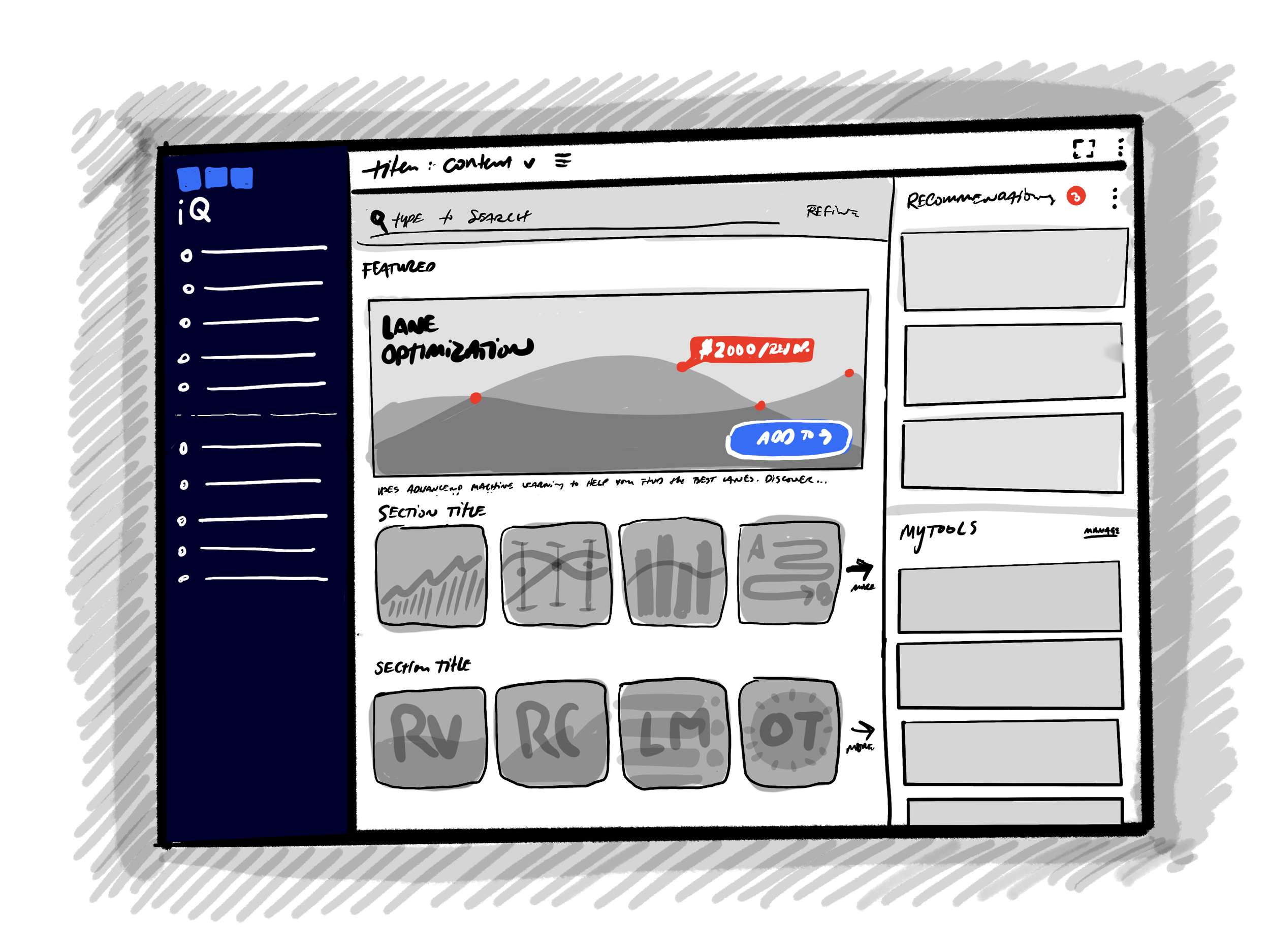
Early design exploration focused on the dashboard architecture — how to present rate history, lane performance, market conditions, and forecasts in a single configurable view without overwhelming users. The sketches established the widget-based layout, the left navigation model, and the chart/map/table composition that would carry through to final designs.
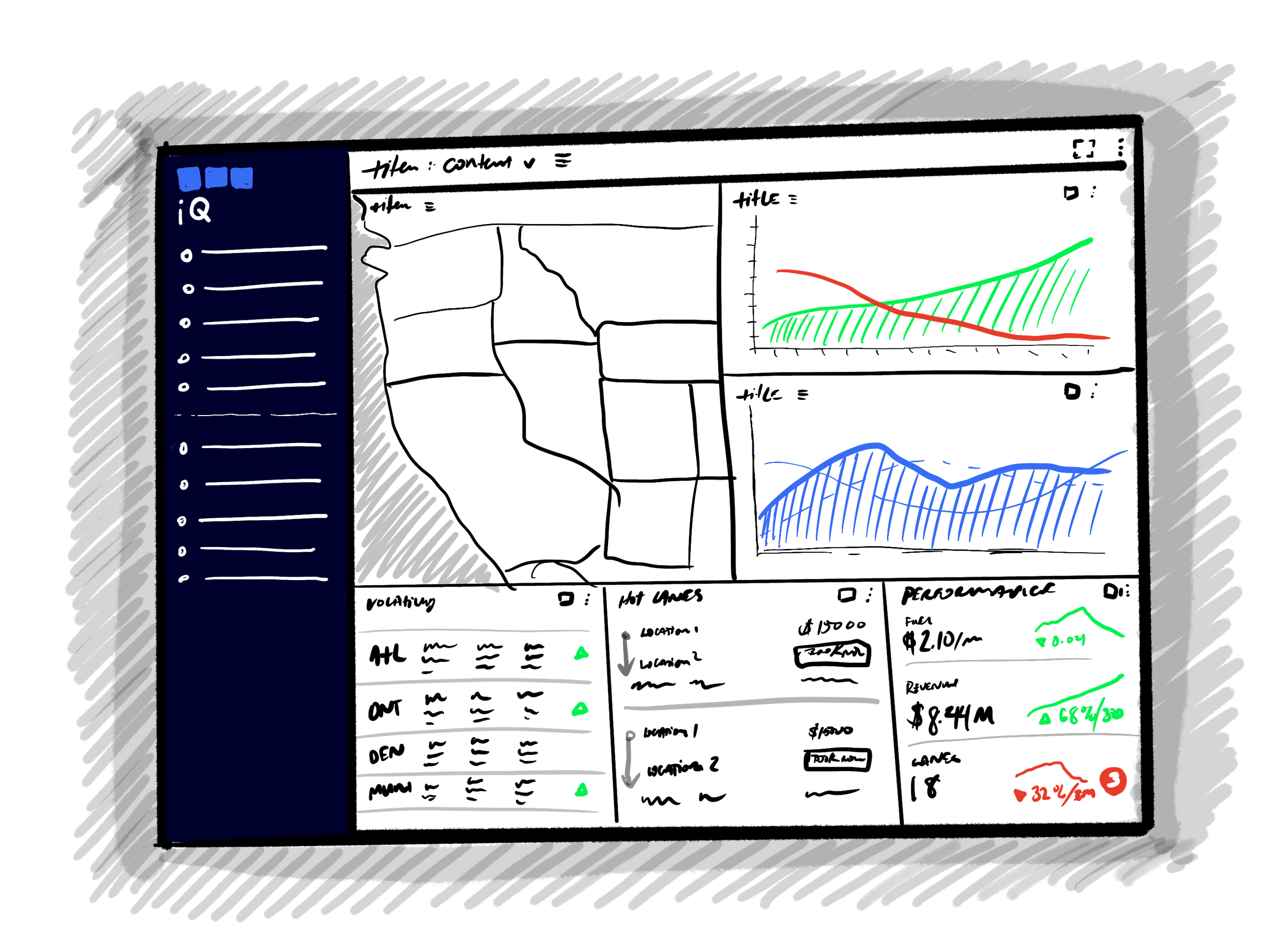
Early dashboard sketch with charts, graphs, and data tables
Dashboard concept. Line graphs, market conditions, and data tables in early layout exploration.
Marketplace dashboard sketch
Marketplace concept. Early sketch of the Growth stage marketplace and tools dashboard.

High-Fidelity Design — Dashboards

Custom dashboards with real-time data, configurable widgets, and dark/light modes.

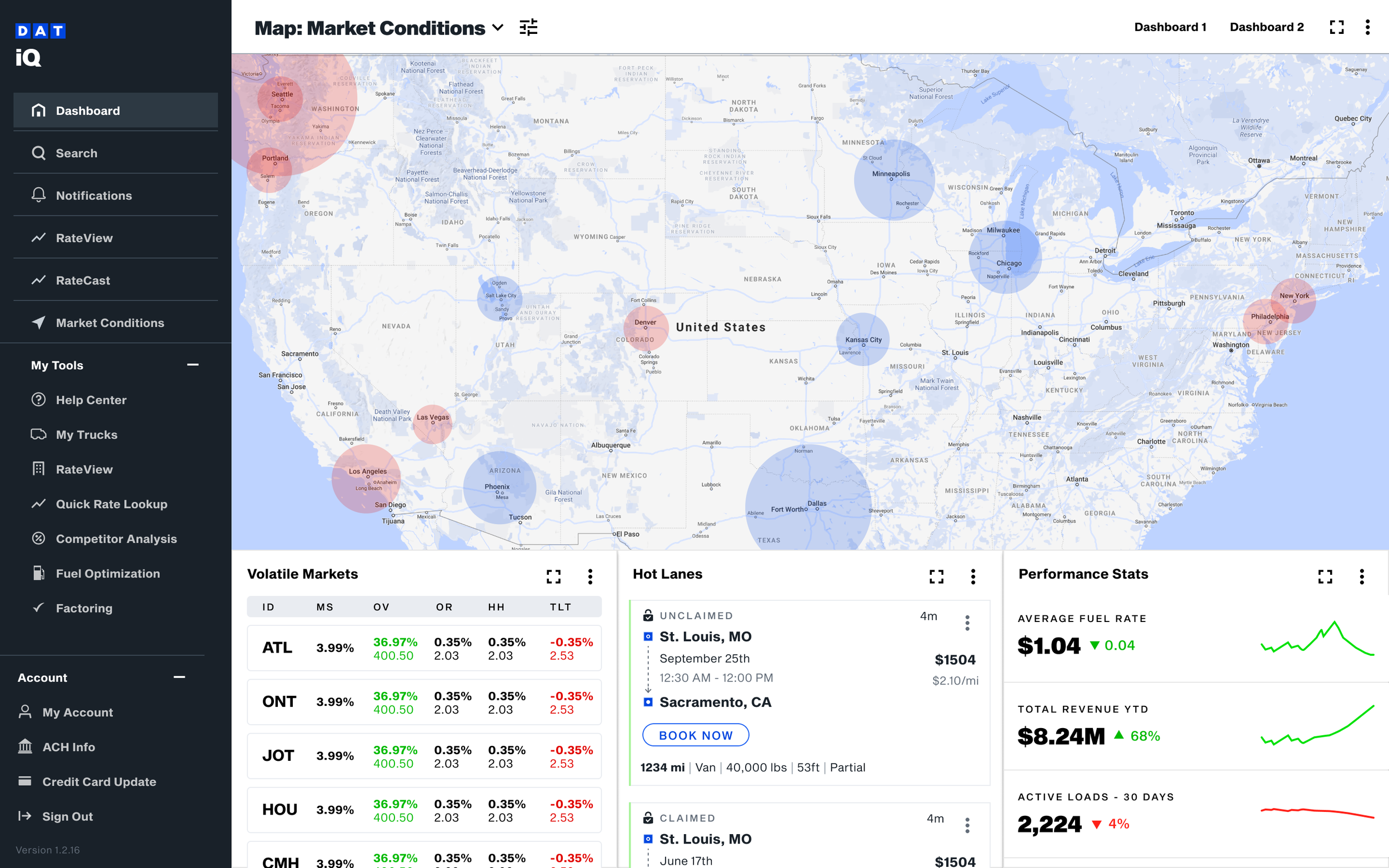
The custom dashboard was the entry point for every DAT iQ session — a configurable home base where users could surface the metrics most relevant to their role. Rate trends, lane performance, market condition indices, and forecast data were all available as widgets, arranged to match individual workflows.
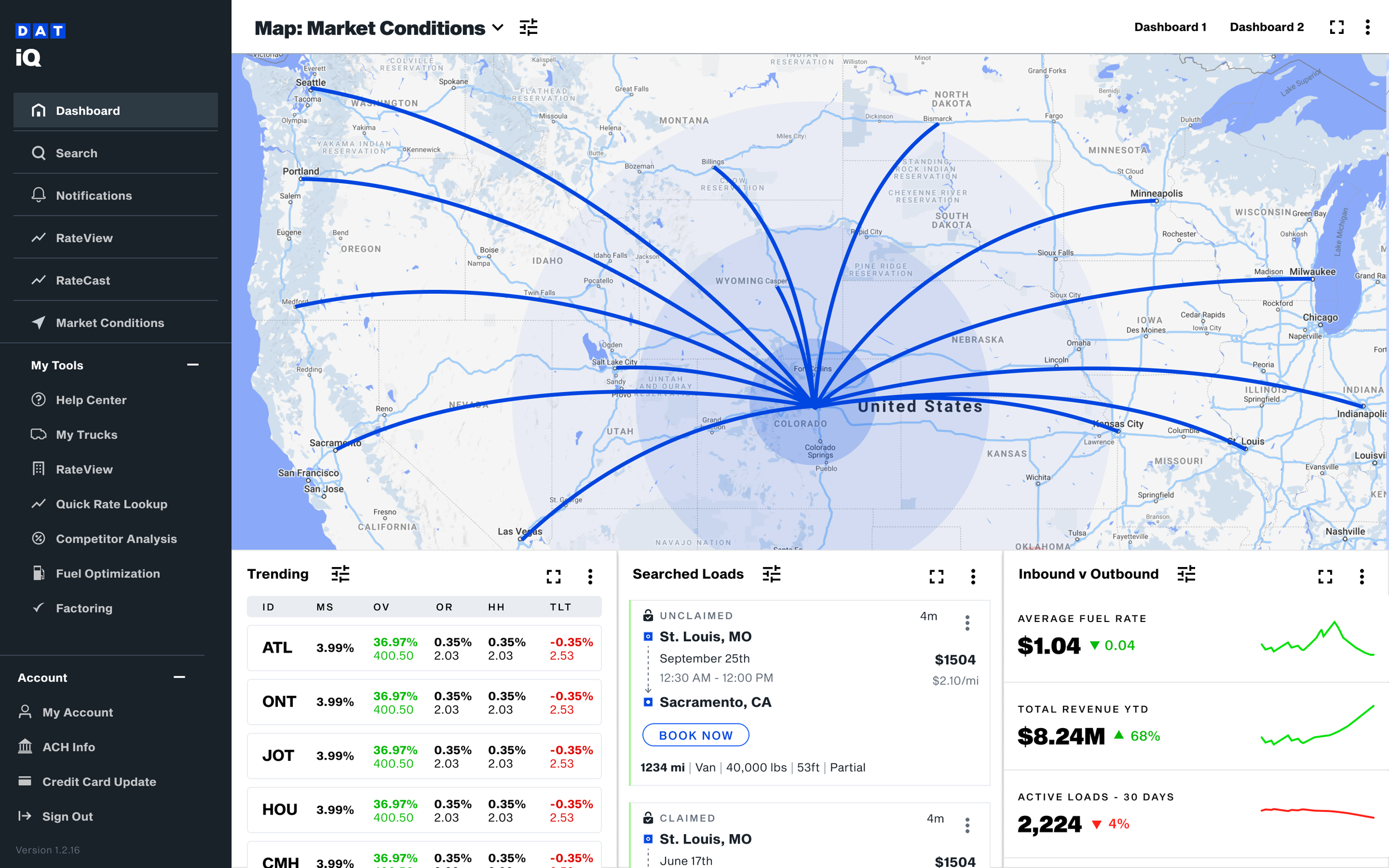
DAT iQ dashboard view 1
DAT iQ dashboard view 2
DAT iQ geo dashboard dark mode
Custom dashboards — dark and light. Configurable widget layouts surfacing rates, conditions, and geographic data. Both themes designed from the ground up for their respective use contexts.

High-Fidelity Design — Rates

Rate history, forecasting, and single-lane analysis — with configurable time ranges and fuel adjustments.

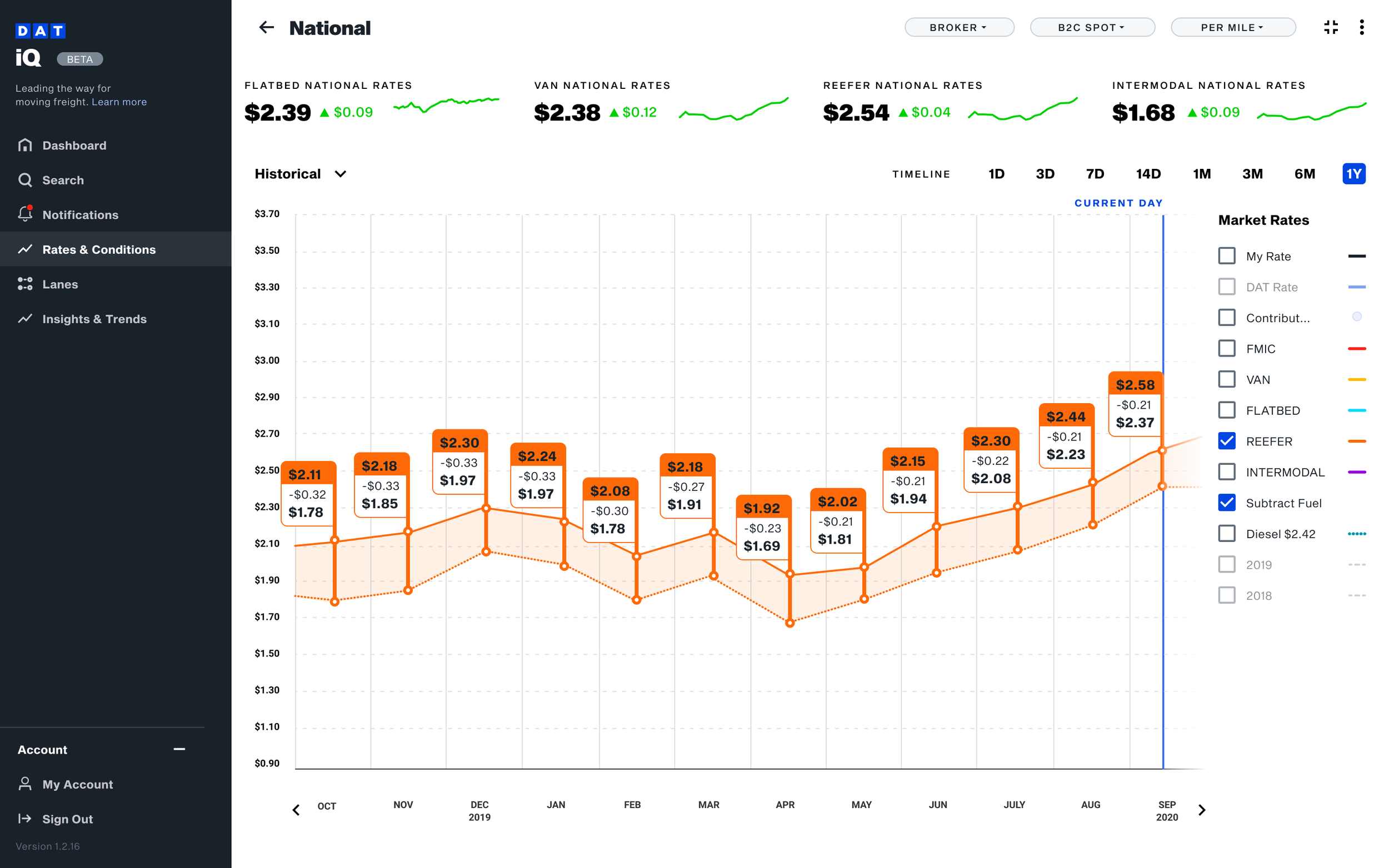
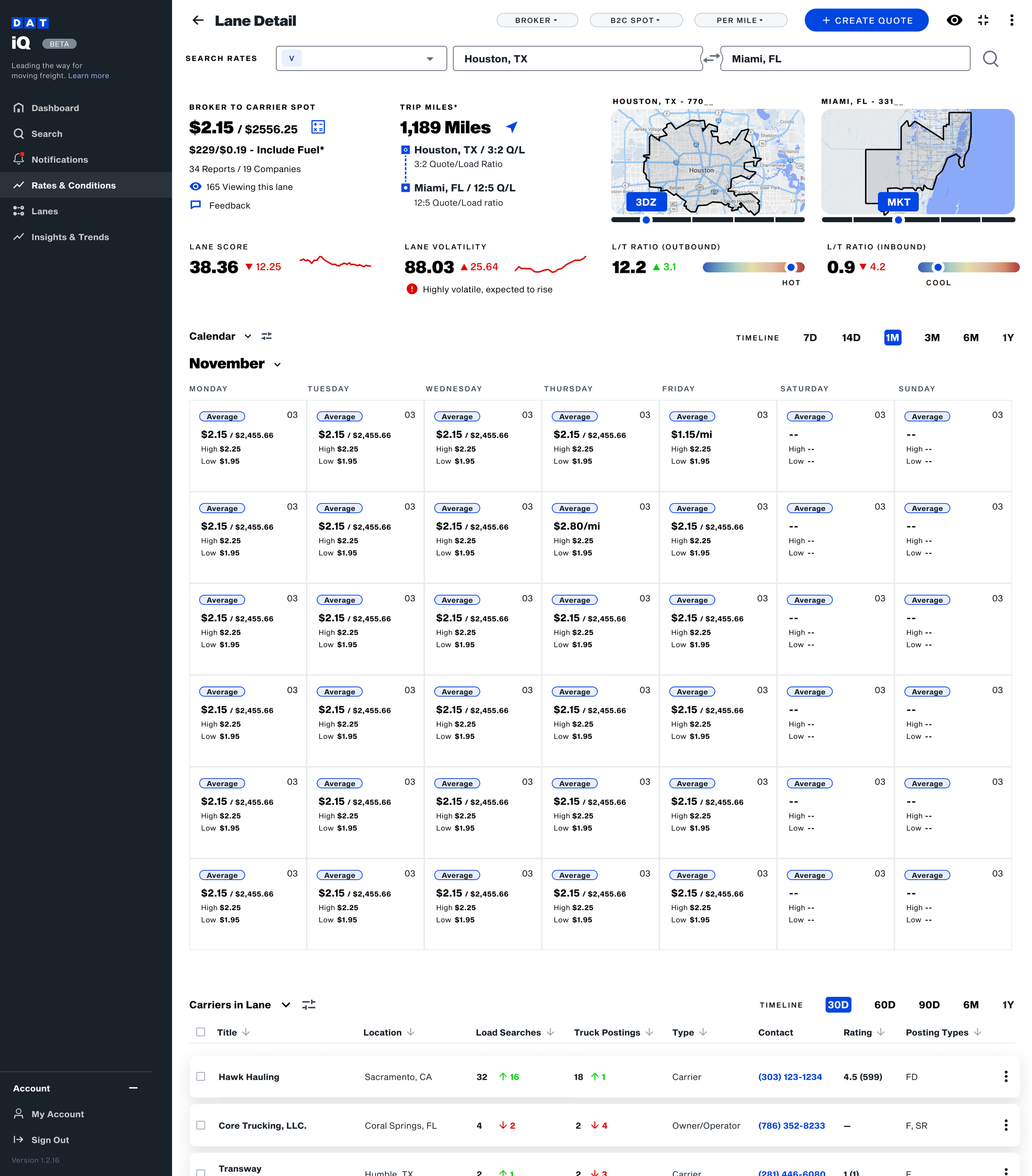
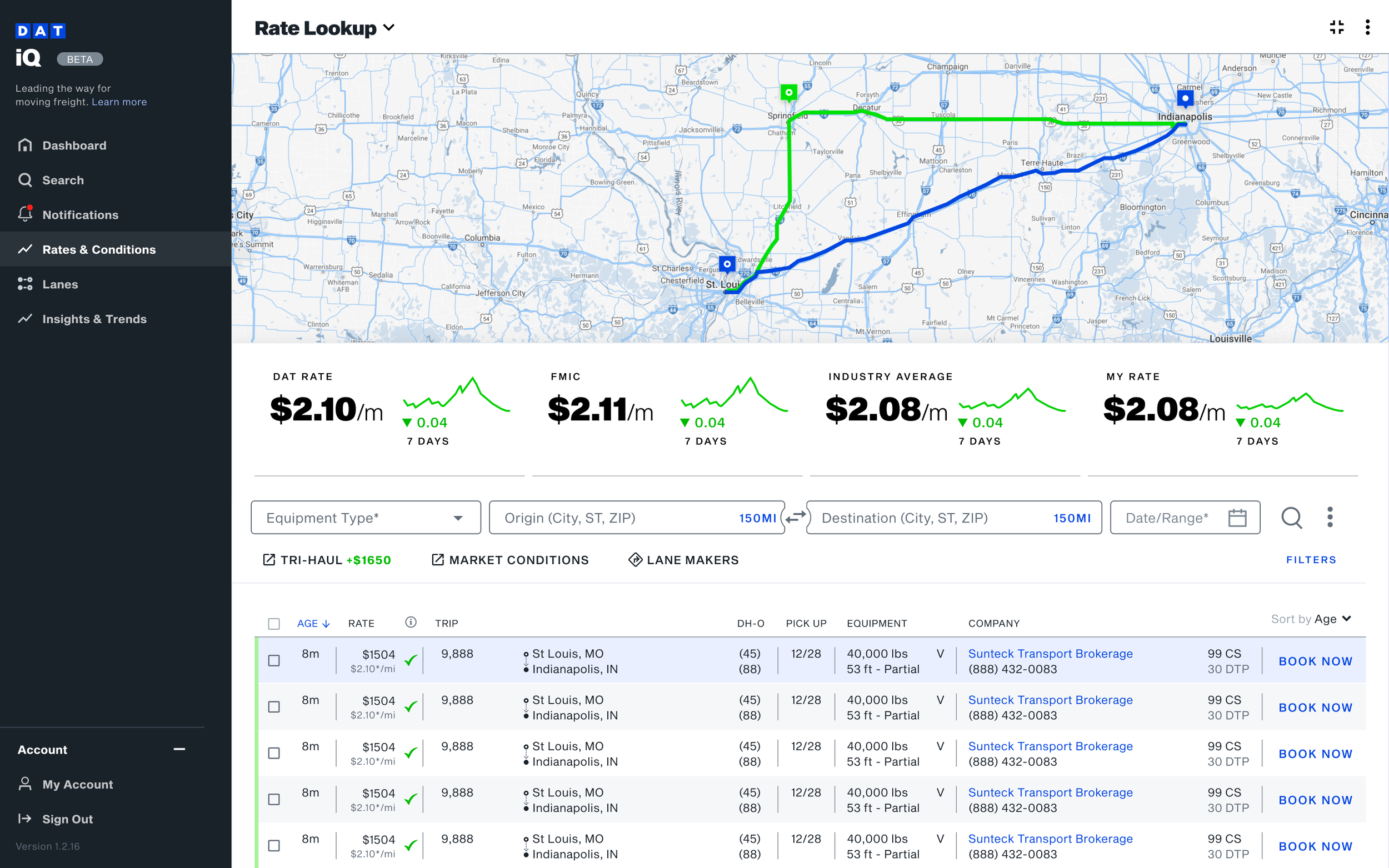
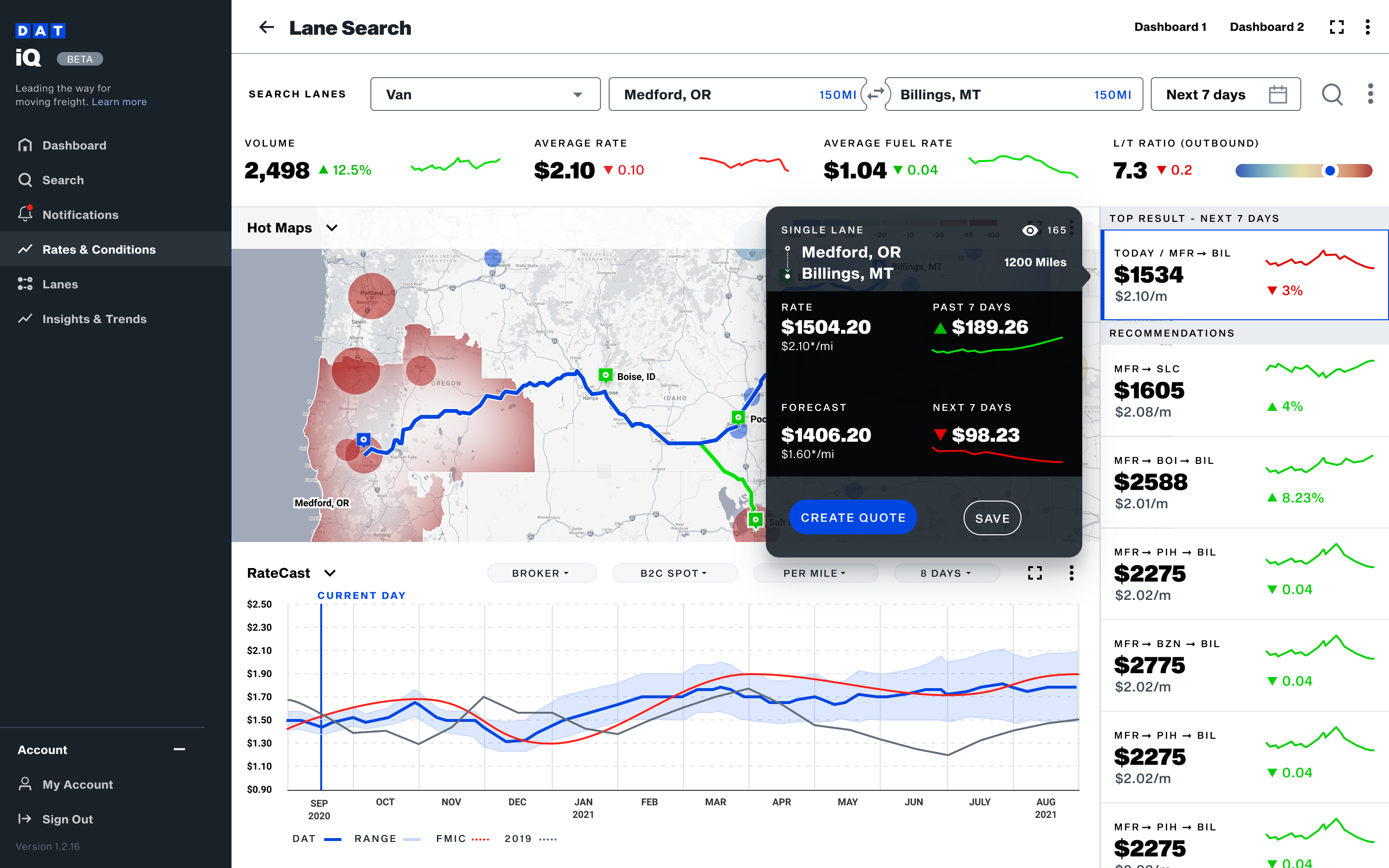
The rates experience was the core of DAT iQ v1.0 — consolidating Rateview and Ratecast into a single view that could show national rate history, per-lane spot and contract rates, fuel-adjusted figures, and short-term forecasts in a single, filterable interface. The business calendar view gave brokers a forward-looking rate planning tool that didn't exist anywhere in the existing DAT product suite.
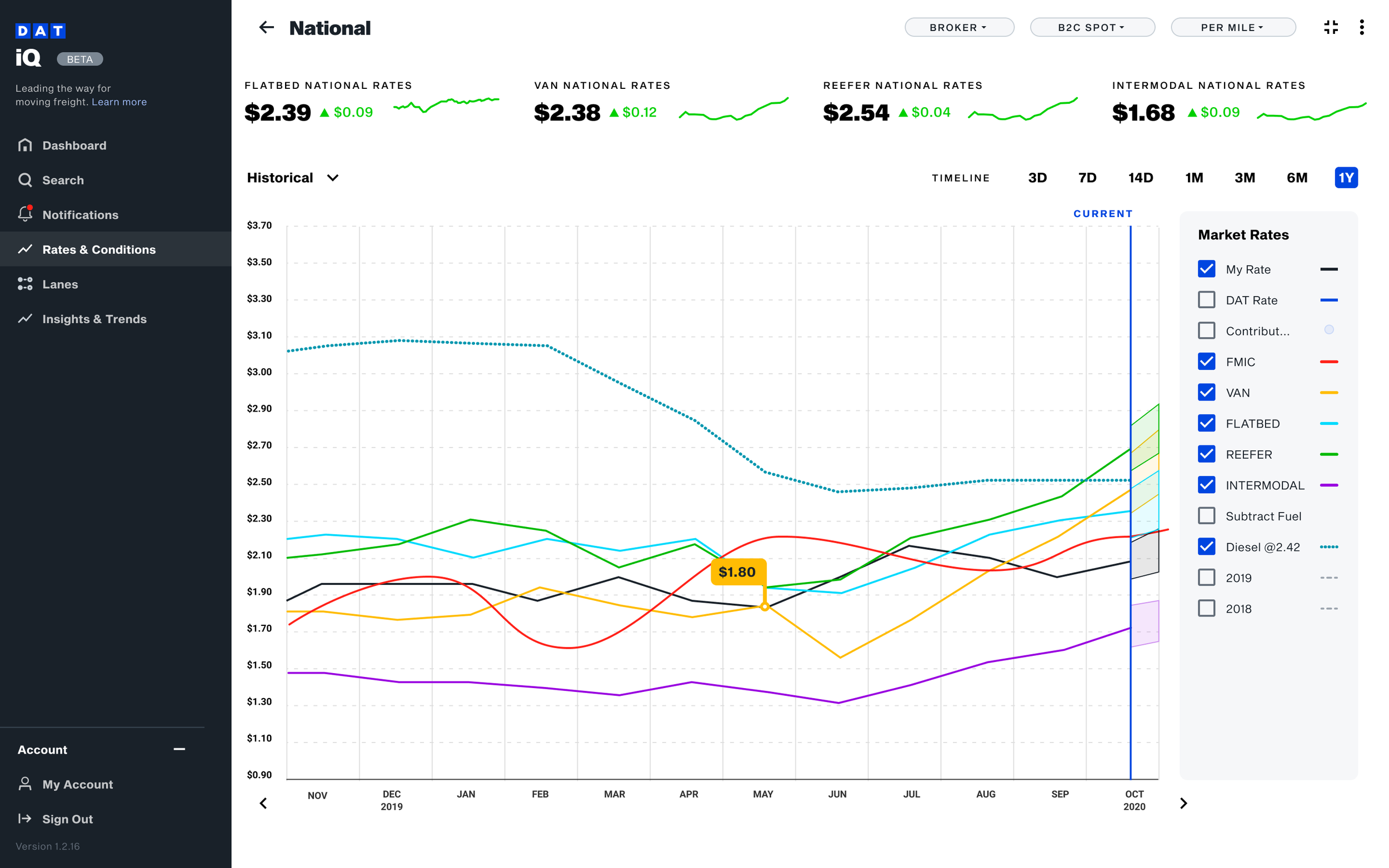
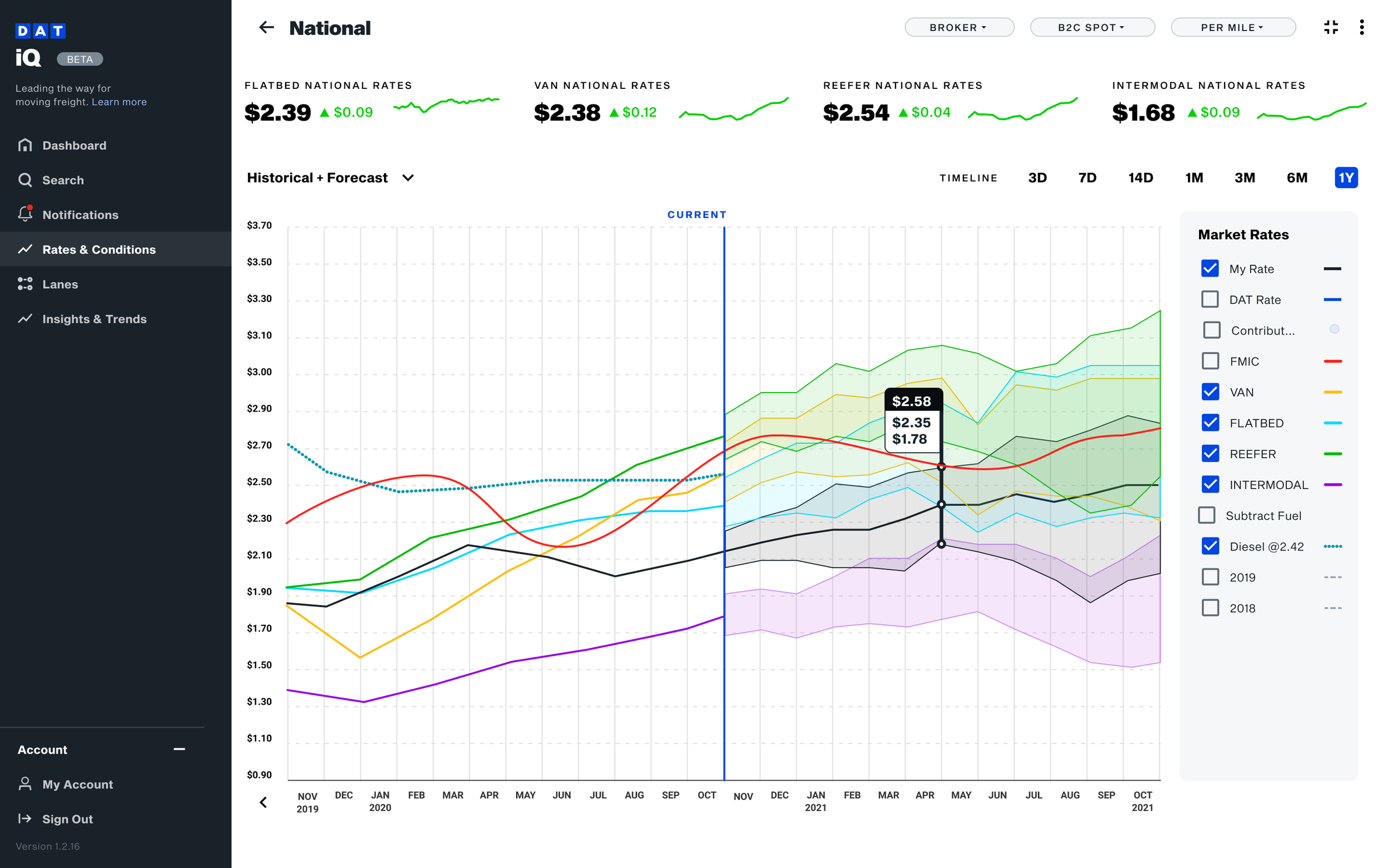
Rates — scroll to explore. National history, hybrid views, fuel-adjusted reefer rates, single-lane analysis, and the business calendar planning view.

High-Fidelity Design — Lanes

Lane management at scale — search, save, monitor, and act.

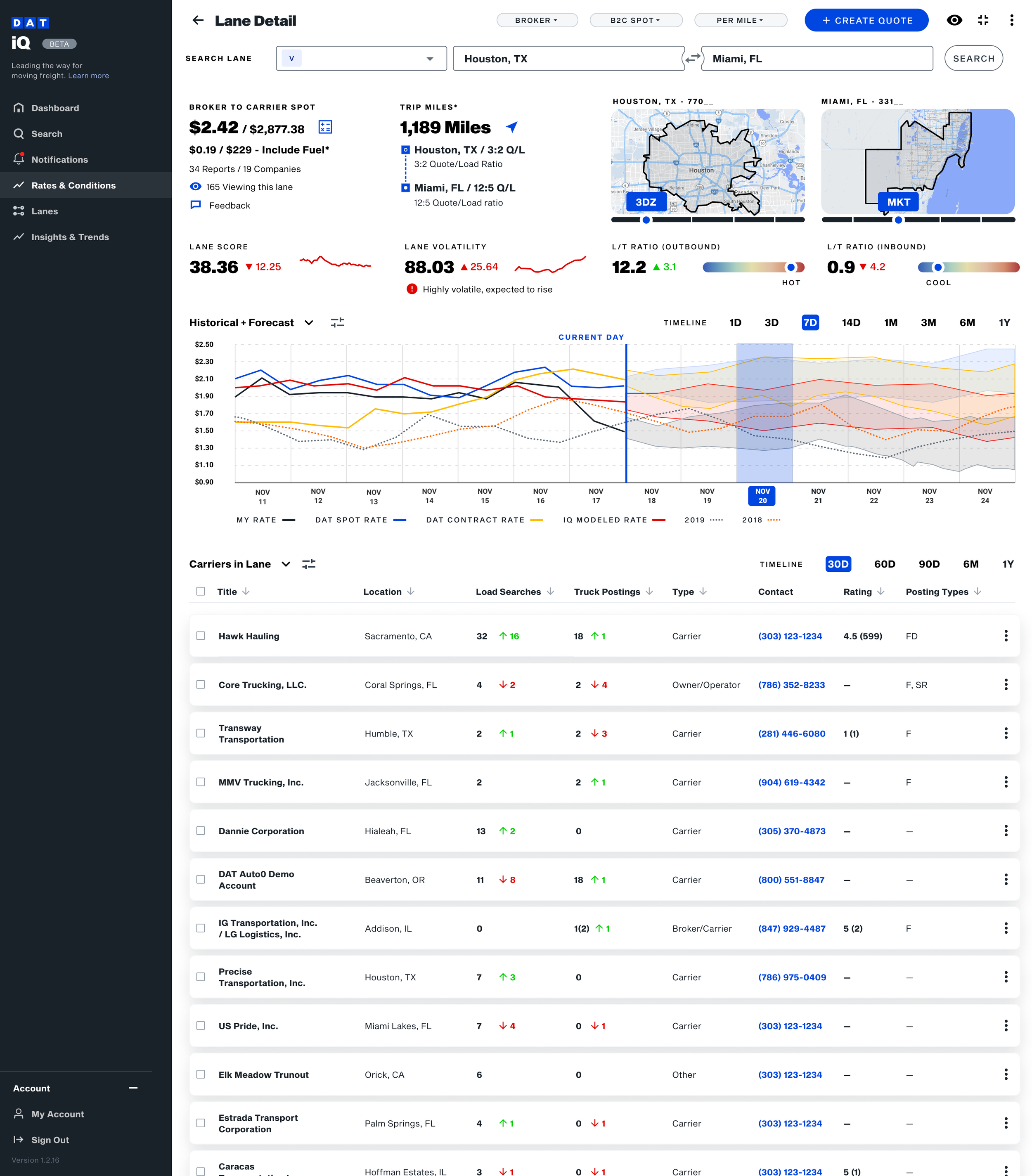
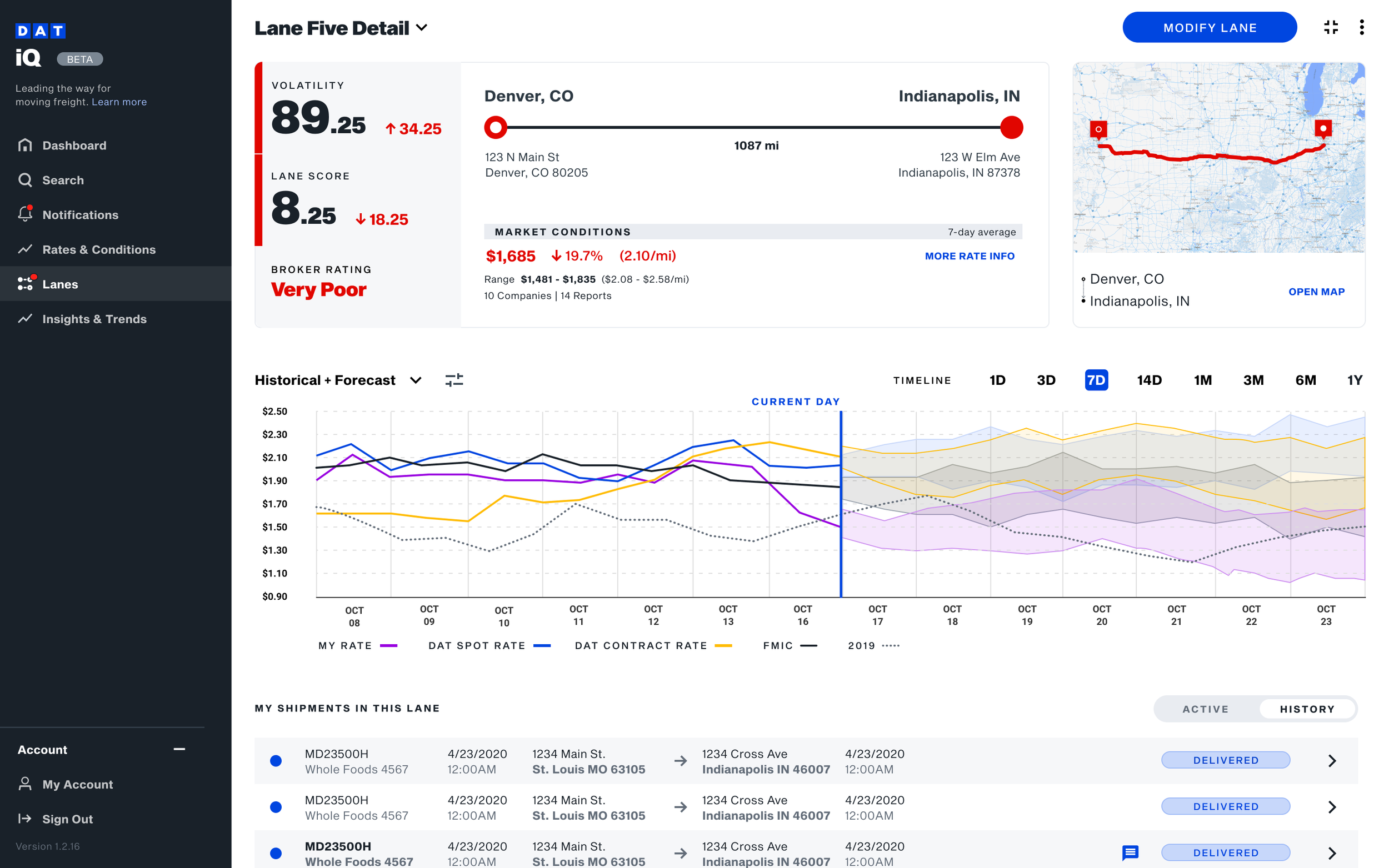
Lane management was the operational center of gravity for brokers and shippers who needed to track performance across dozens or hundreds of freight lanes simultaneously. The lanes experience let users build a personal lane portfolio, monitor rate movements and volatility, and drill into individual lane detail with historical performance, market conditions, and forecasted rate changes.
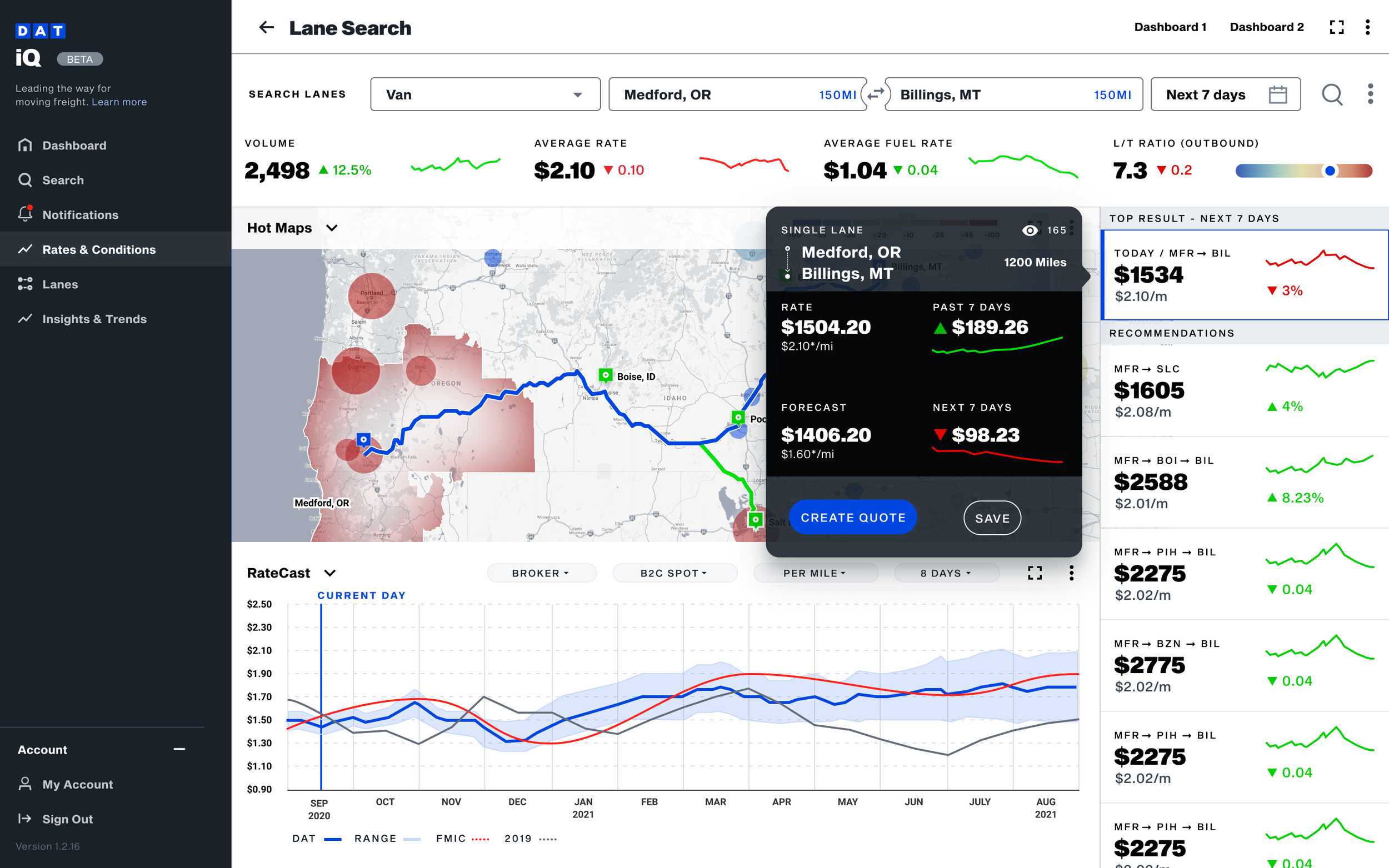
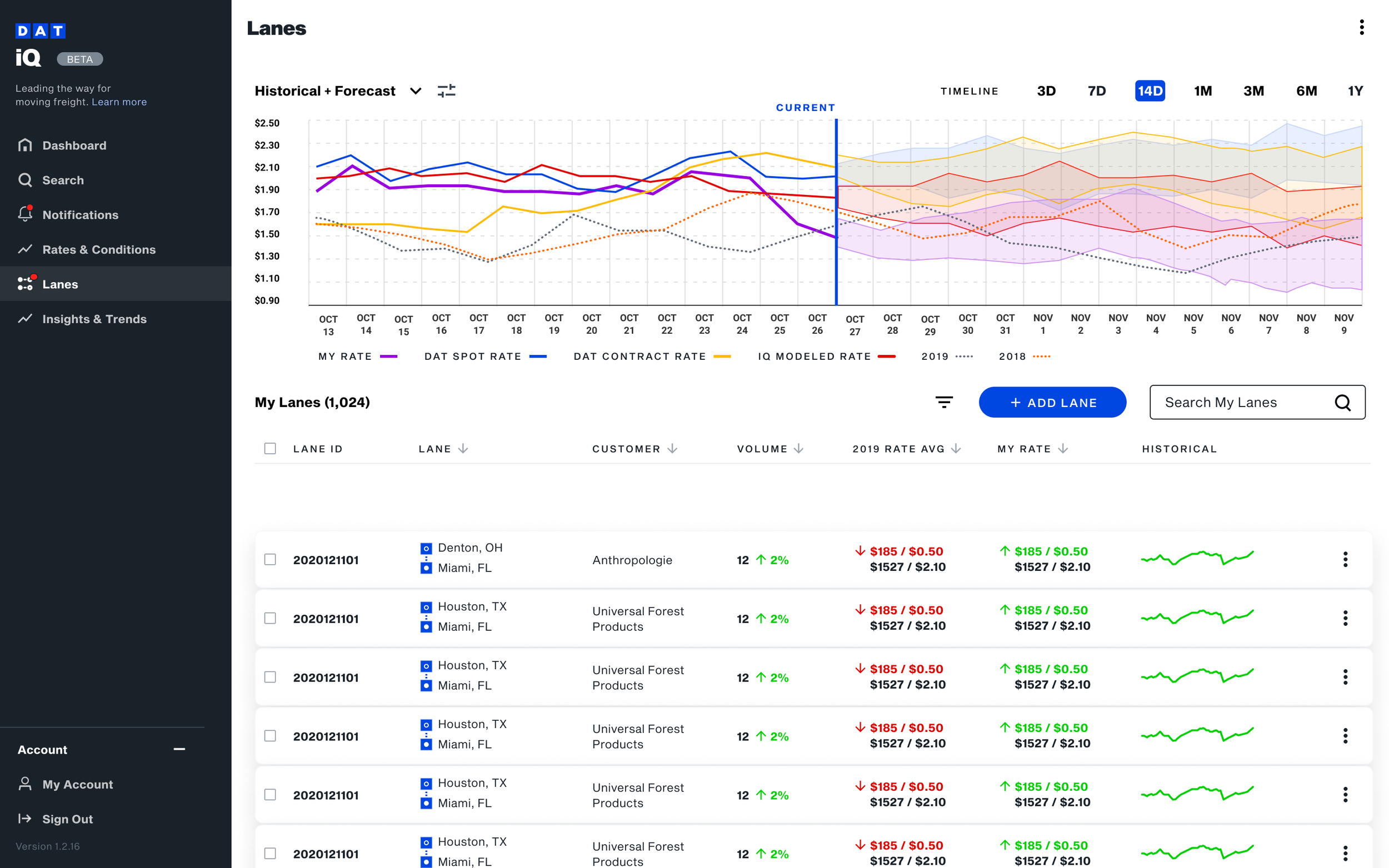
DAT iQ lane rates and map view
Lane intelligence — map + rates. Route visualization, market conditions, and rate data unified in a single lane view. Boise, ID → Billings, MT with current, forecast, and historical rate graphs.
Lanes overview with saved lanes
My Lanes. Saved lane portfolio with rate trend sparklines, volatility indicators, and lane score.
Lane detail view with volatility and market conditions
Lane Detail. Volatility, lane score, broker rating, market conditions, route map, historical and forecast rate graph.
Lane search interface
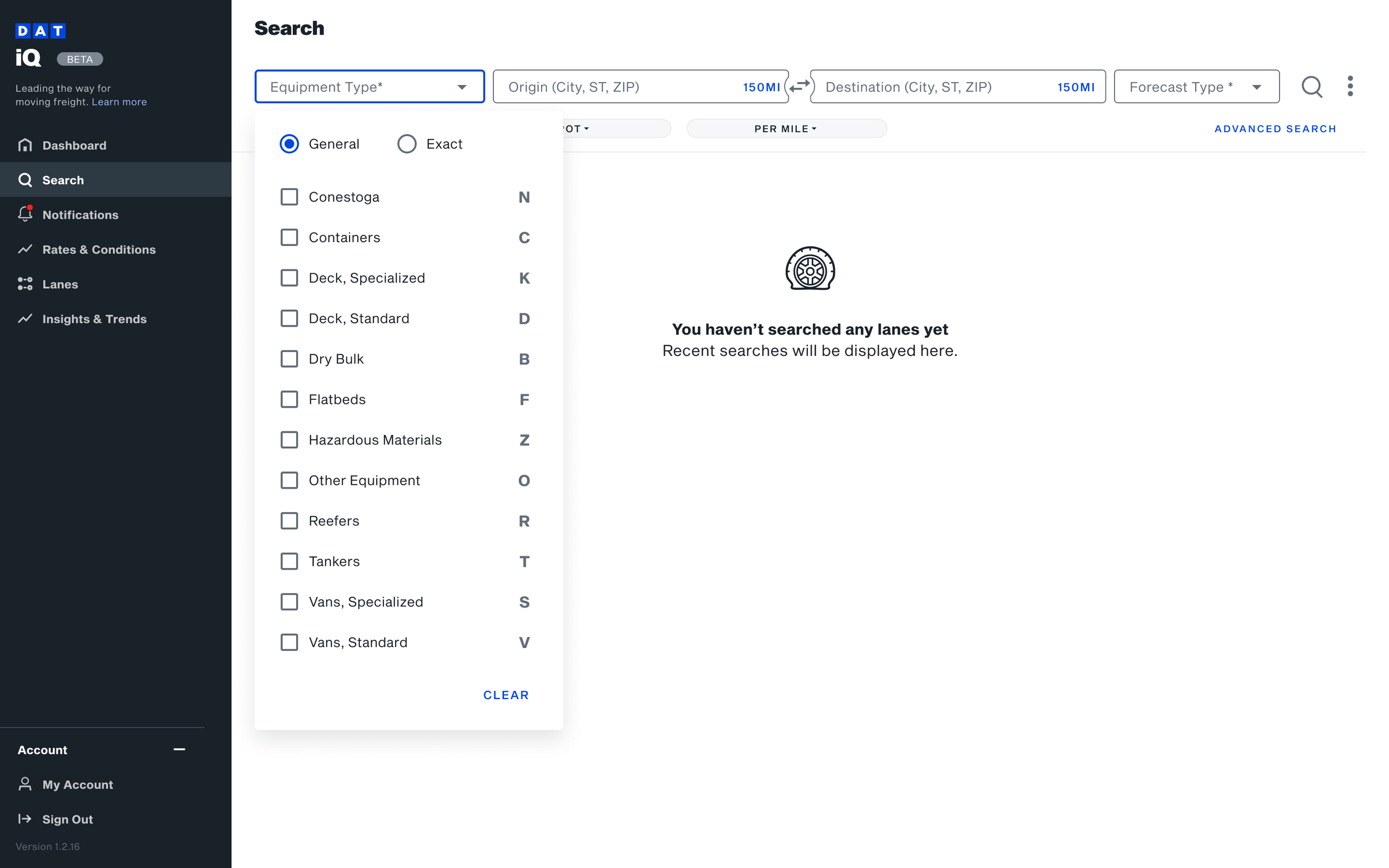
Lane Search. Origin/destination lookup with recent searches and top lanes surfaced immediately.
Hot lanes combo rates view
Hot Lanes. Market-wide lane heat map with combo rate view — spot and contract rates in a single comparative layout.

DAT iQ Freight Intelligence will drive the next generation of freight forward through Advanced Freight Intelligence — powering your business beyond tomorrow's volatile markets.

This was the opening line of the executive pitch. It wasn't just positioning copy — it was the north star that oriented every design decision for nine months. Create clarity. Deliver smart notifications. Analyze business performance. Automate action. Optimize transactions.

The vision secured the budget. The design delivered the platform. And the senior designer I hired and onboarded before leaving ensured it continued to evolve after I moved on to Orderful.


Outcomes

A platform built from zero. A vision that funded the future.

DAT iQ was a nine-month zero-to-one build under conditions that required both deep craft and executive-level strategic thinking. The design work wasn't just about screens — it was about convincing a large, established company to invest in a new product category and a new way of thinking about freight intelligence.

0→1
Industry-first freight intelligence platform designed from zero as a founding team member. No precedent — built from customer research up.
5→1
Five legacy DAT products — Rateview, Ratecast, FMIC, MCI, Lanemakers — consolidated into a single unified intelligence experience.
$MM
Multi-year design vision secured millions in executive budget — demonstrating DAT iQ as a long-term platform investment, not a one-off product.
Team
Hired and onboarded the first senior product designer, establishing team structure and handoff foundations that carried the platform into its next phase.
View all work
Back to portfolio
View all case studies →