AngelMD · Head of Design · 2019–2020

Redesigning How
Physicians, Investors,
and Startups Invest
Together

A multi-sided healthcare investment platform connecting early-stage medical startups with a community of physician-investors. The core design challenge wasn't the UI — it was rearchitecting an account model that assumed users were one thing, when the reality of healthcare investing meant most were two or three at once.

3→1
Role types unified under
a single base account model
3×
User segments served:
physicians, investors, founders
Full-stack
Platform redesign: web,
mobile app, deal flow, syndicate
Role
Head of Design
Timeline
Oct 2019 – Aug 2020
Platforms
Web, iOS, Android
Scope
Account model, deal flow, syndicate, mobile app
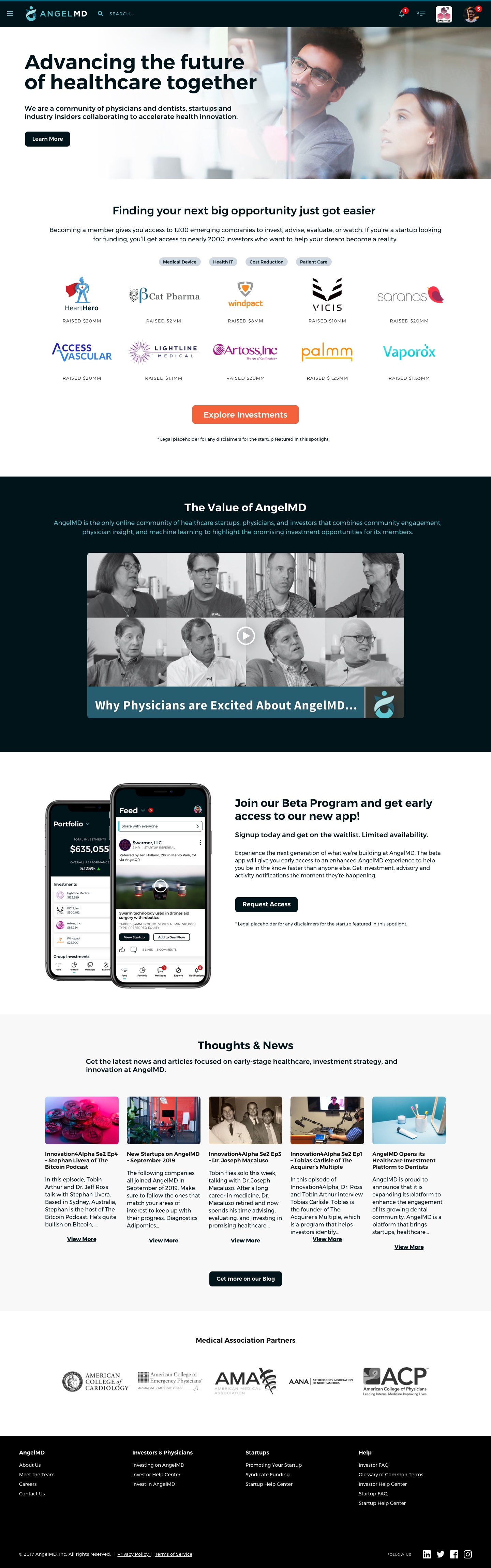
AngelMD homepage — advancing the future of healthcare together
AngelMD platform homepage. A community of physicians, dentists, startups, and industry insiders collaborating to accelerate health innovation — with access to 1,200+ emerging companies and nearly 2,000 investors.

The Core Problem

The original design assumed physicians, investors, and founders were three separate people. They weren't.

When I joined AngelMD, the platform was built around a strict role-based model: you were either a physician, an investor, or a startup founder. Each role had its own onboarding path, its own interface assumptions, its own set of permissions and objectives. The design was clean and logical — if you accepted the premise that these three archetypes were mutually exclusive.

The premise was wrong. In healthcare investing, the most active and valuable users were physicians who were also investors. Some were founders building their own startups while advising others. The model that AngelMD had built didn't accommodate this reality — it forced users into a single lane and made the experience arduous for anyone whose professional identity crossed boundaries.

The insight

The fix wasn't cosmetic. It required rearchitecting the account model itself — moving from role-as-identity to role-as-layer. A single base account that a user could augment with clinical, investor, and founder profile layers, each activating the relevant features and objectives without forcing a choice that didn't reflect how users actually existed in the world.
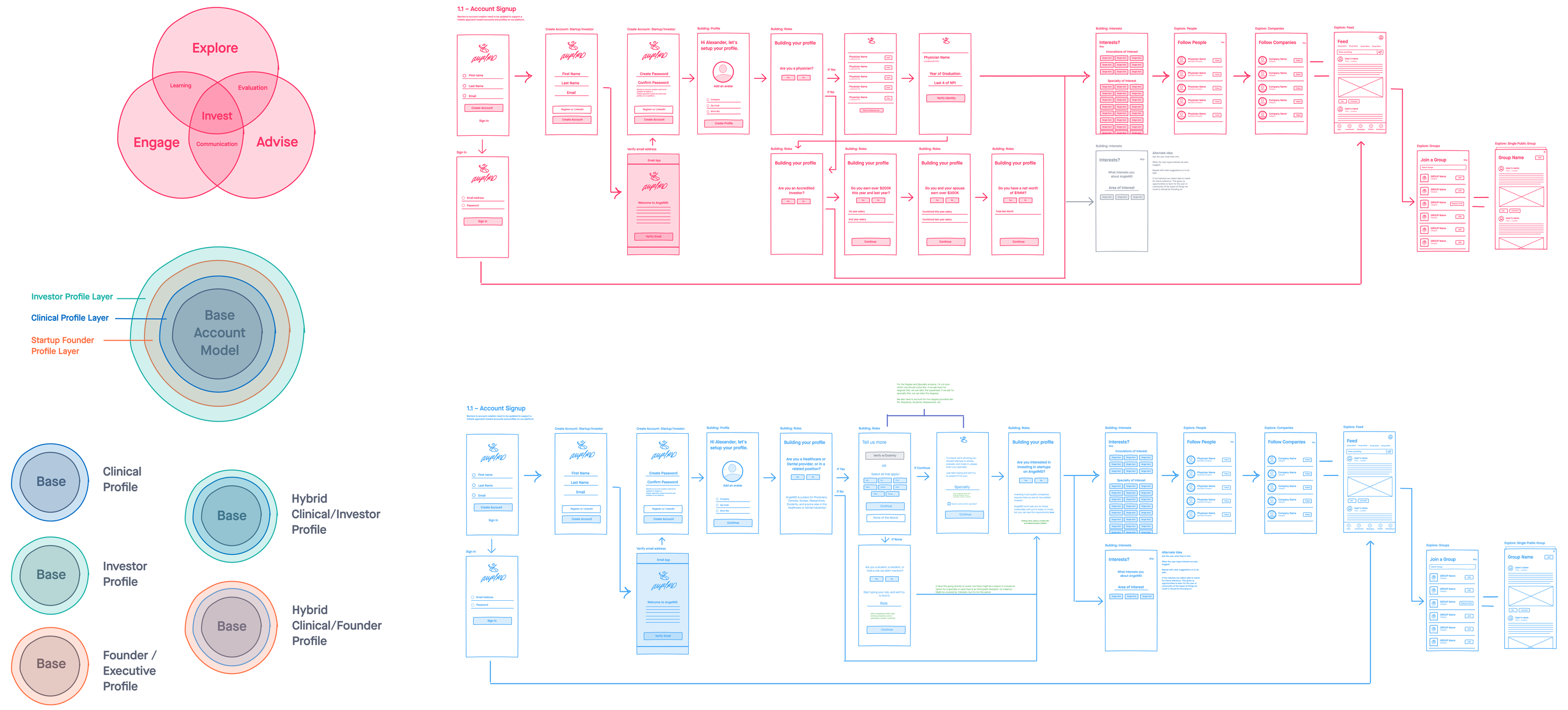
AngelMD account model redesign — Base Account + role layers diagram and full onboarding flow map
Account model redesign + onboarding flow map. Left: the concentric circle model — a single Base Account with Clinical, Investor, and Founder layers that activate independently. Right: the full onboarding flow mapped across both the original single-role path (pink) and the new hybrid-capable path (blue). The diagram shows how a physician-investor routes through a fundamentally different experience than a single-role user.

Account Architecture

From mutually exclusive roles to a layered identity model.

The original architecture treated user type as a primary identity — a choice made at signup that determined everything downstream. Change your role, change your experience. The problem wasn't just UX friction — it was a structural ceiling on how engaged and valuable any individual user could become to the platform.

The new model introduced a Base Account as the universal foundation, with role-based profile layers that users could add over time. Each layer — Clinical, Investor, Founder — unlocked the relevant features and objectives for that context, while the base account maintained shared identity, network connections, and platform history across all of them.

Before — Role as Identity
  • Signup forced a single role selection
  • Physician, investor, or founder — choose one
  • Hybrid users hit walls constantly
  • Switching context required workarounds or separate accounts
  • Onboarding paths were siloed and couldn't converge
  • Most actively engaged users couldn't represent their full identity
After — Role as Layer
  • Single Base Account established at signup
  • Clinical, Investor, and Founder layers added independently
  • Hybrid users can hold all three simultaneously
  • Each layer activates relevant features and objectives
  • Onboarding detects context and routes intelligently
  • Full professional identity represented in one account
Clinical Layer
Physician / Clinical Profile
Specialty, credentials, hospital affiliation, clinical expertise. Activates peer evaluation tools, clinical deal assessment, and community advisory features.
Investor Layer
Investor Profile
Investment history, portfolio, accreditation, preferences. Activates deal flow, syndicate participation, group investment tools, and portfolio tracking.
Founder Layer
Startup Founder Profile
Company details, funding stage, team, pitch materials. Activates startup profile management, fundraising tools, and investor outreach features.

Deal Flow

A pipeline view that tracked every startup from referral to investment-ready — inside a physician specialty group.

The deal flow experience was the heart of what made AngelMD different from generic investment platforms. Deals didn't enter a single undifferentiated pool — they were surfaced and evaluated within specialty-specific physician groups (Advanced Surgery, Healthcare CEOs, Innovation4Alpha) where clinical expertise was embedded directly into the diligence process.

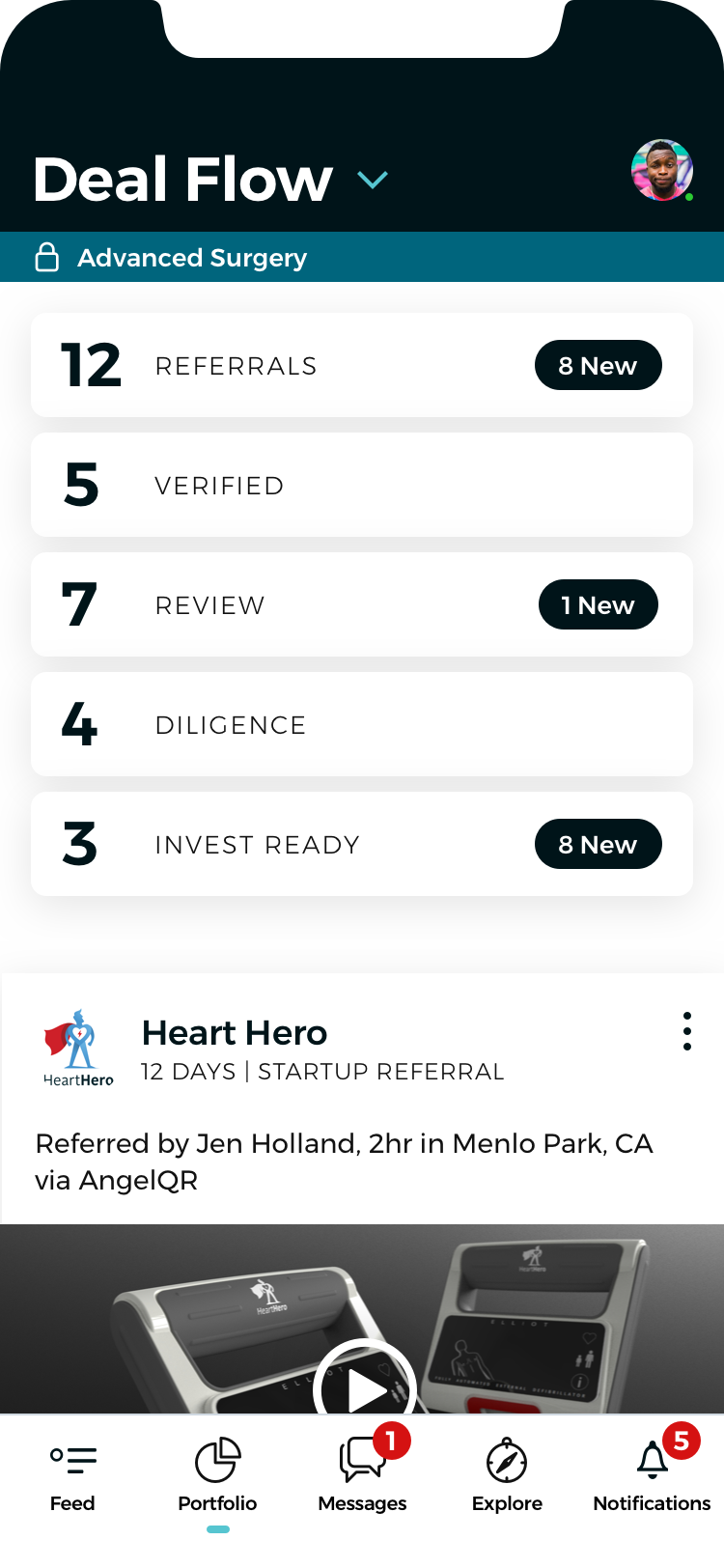
The pipeline tracked five stages — Referrals, Verified, Review, Diligence, Invest Ready — giving group members visibility into exactly where each opportunity stood and what action was needed from them. Action Items and Active Syndicates surfaced on the right rail, keeping members focused on decisions rather than discovery.
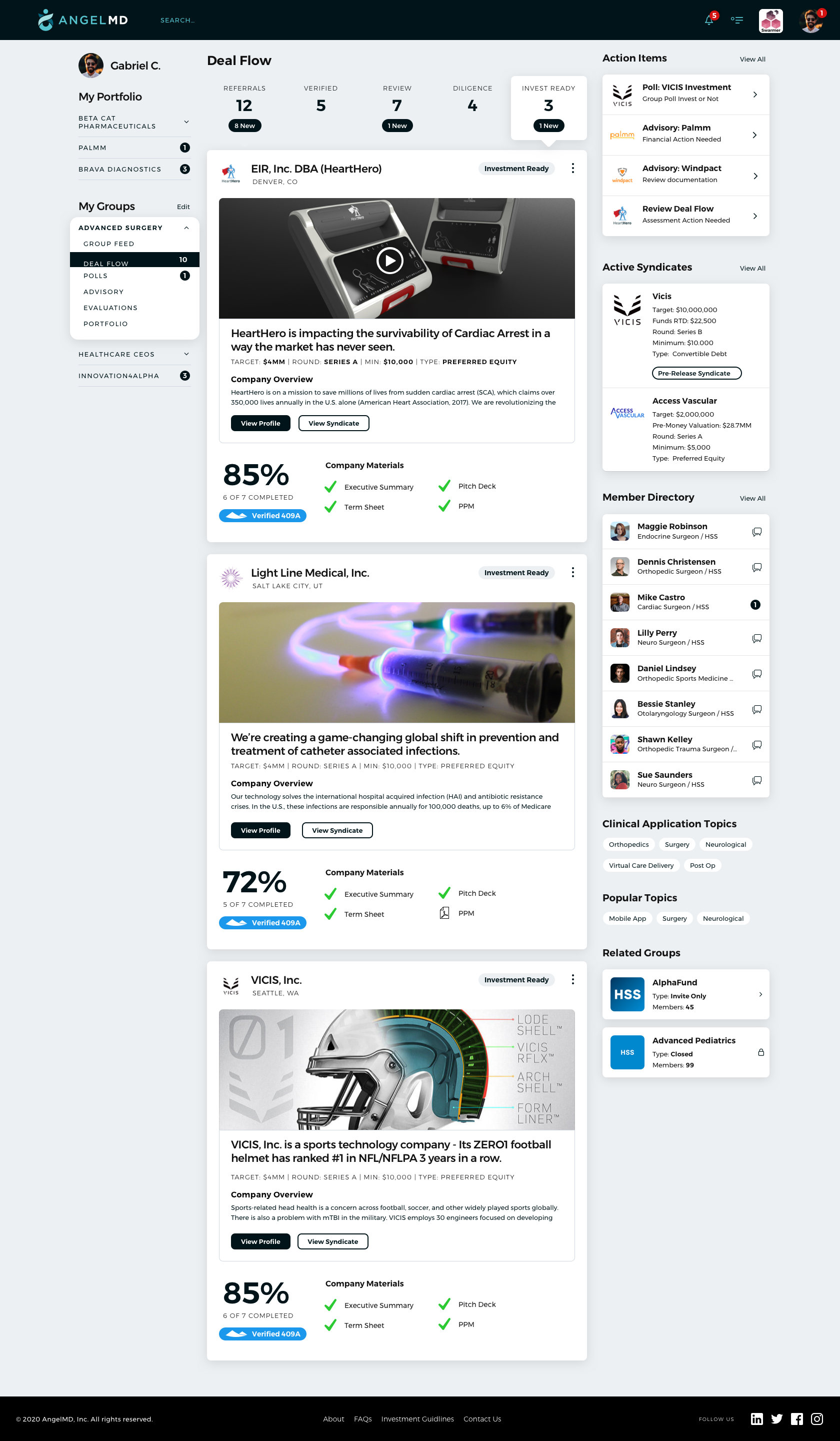
AngelMD deal flow — Invest Ready stage with HeartHero, Light Line Medical, VICIS
Deal Flow — Invest Ready stage. Three companies at investment decision stage (HeartHero, Light Line Medical, VICIS) with completion percentages, verified 409A status, and company materials checklist. Active Syndicates and Member Directory on the right rail. This is a physician's investment dashboard — clinical judgment and deal flow in the same interface.
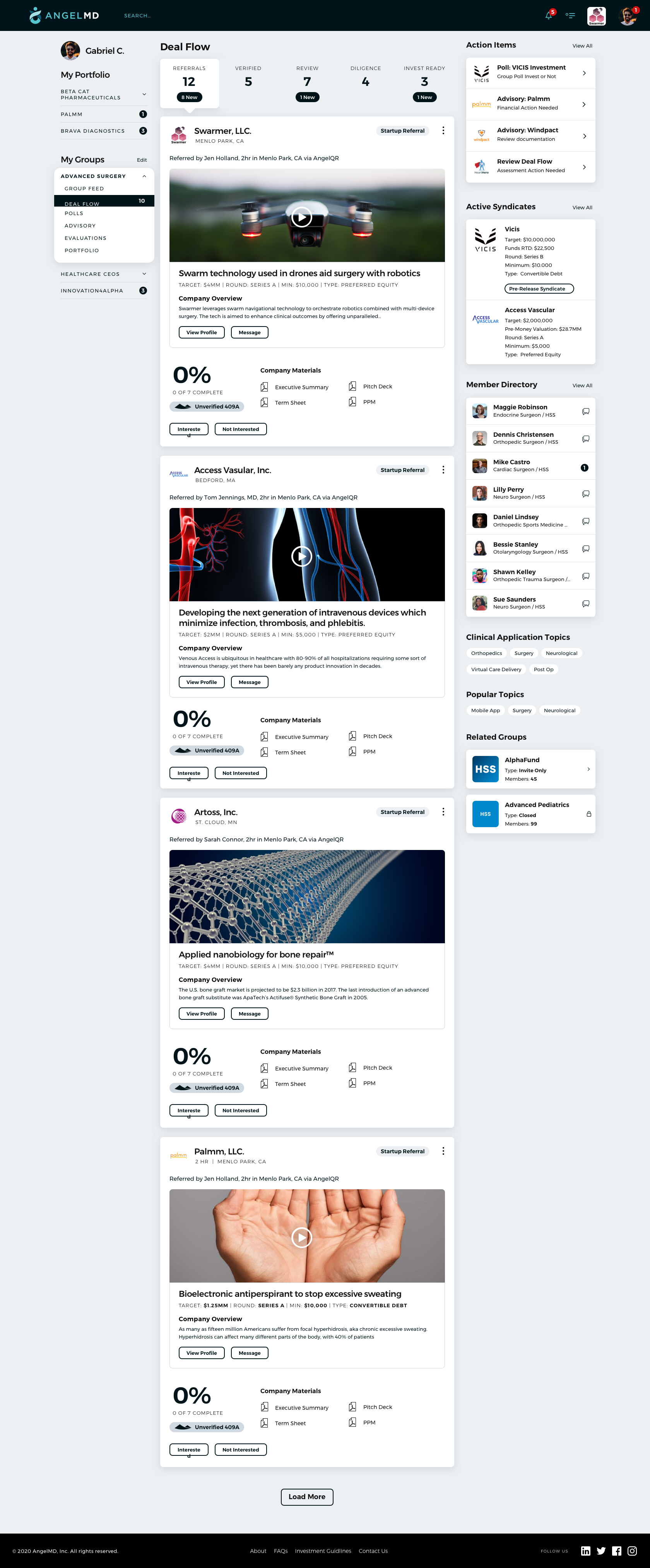
AngelMD deal flow — Referrals stage with startup referral cards
Deal Flow — Referrals stage. Incoming startup referrals with source attribution (referred by name, location, via AngelQR), company overview, completion percentage, and interest/not interested triage. The referral system brought trusted deal sourcing directly from the physician network.

Syndicate & Group Investment

The social layer that made group investing feel like a community decision, not a transaction.

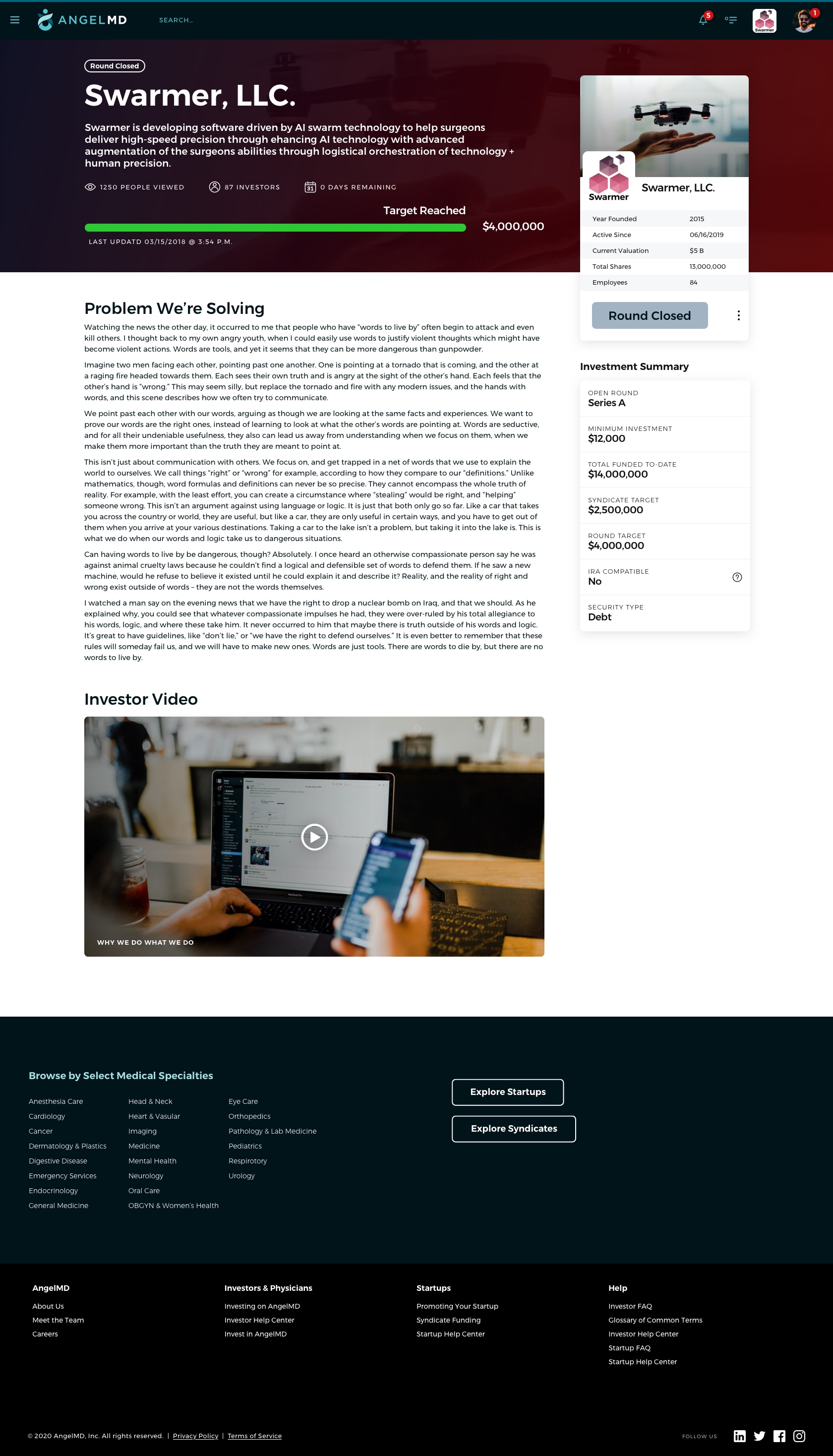
Syndicate investing — where a group of investors pools capital behind a single lead — is structurally complex and typically opaque. AngelMD's syndicate design made the group investment process transparent and social: visible progress toward funding targets, real-time investor counts, days remaining, and company information all surfaced on a single deal page.

The two states of a syndicate — Active and Round Closed — each carried different design priorities. Active deals needed urgency signals and clear calls to action. Closed rounds needed to communicate outcomes and preserve the record of the community's collective decision.
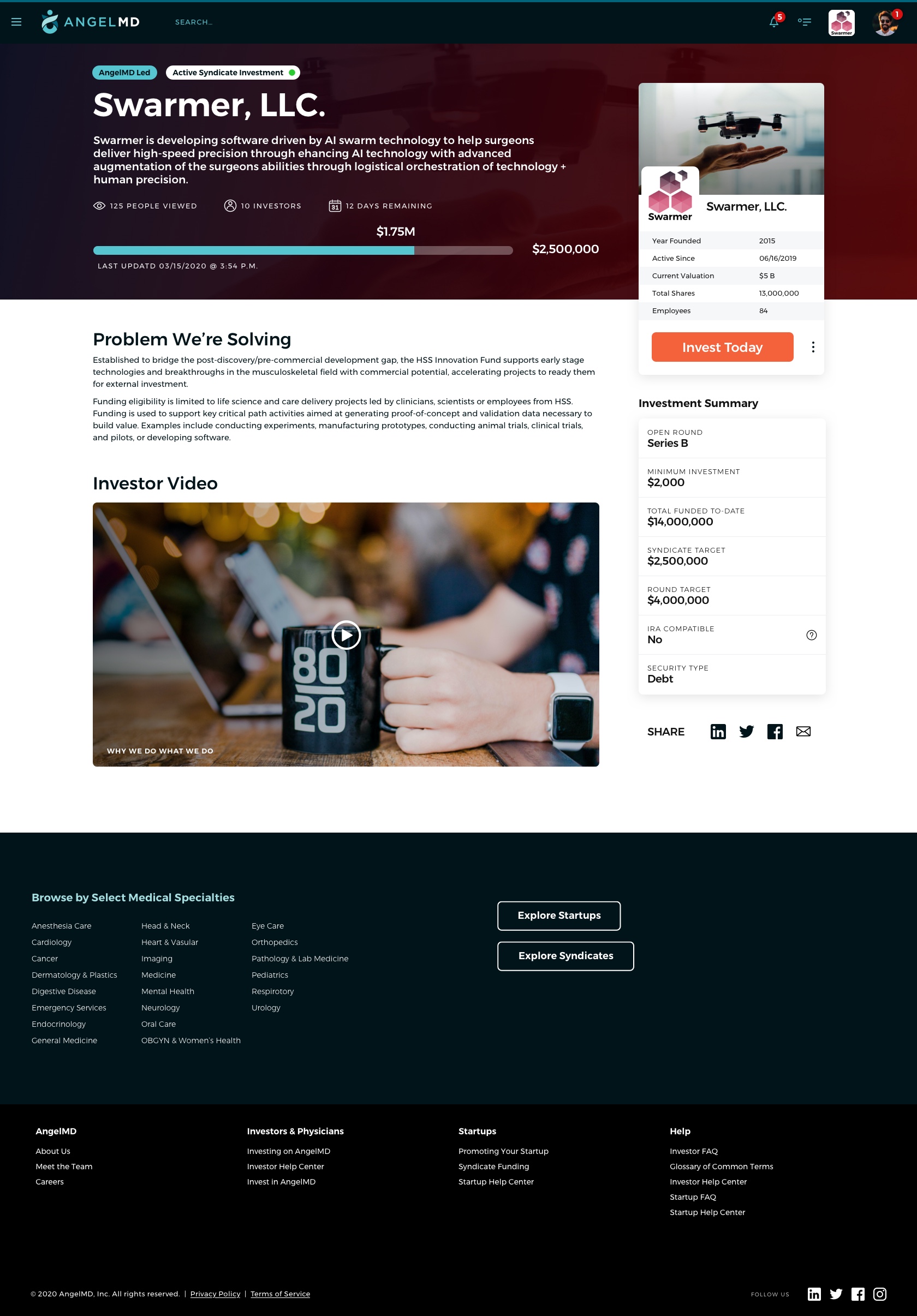
Swarmer LLC — Active Syndicate Investment, $1.75M of $2.5M raised
Active Syndicate — Swarmer, LLC. $1.75M raised of $2.5M target. 10 investors, 12 days remaining. Investment summary sidebar with minimum investment, security type, IRA compatibility. Funding progress bar with live update timestamp.
Swarmer LLC — Round Closed, $4M target reached
Round Closed — Swarmer, LLC. Target reached at $4M. 87 investors. The closed state shifts from urgency to record — preserving the outcome and the community's participation for future reference.
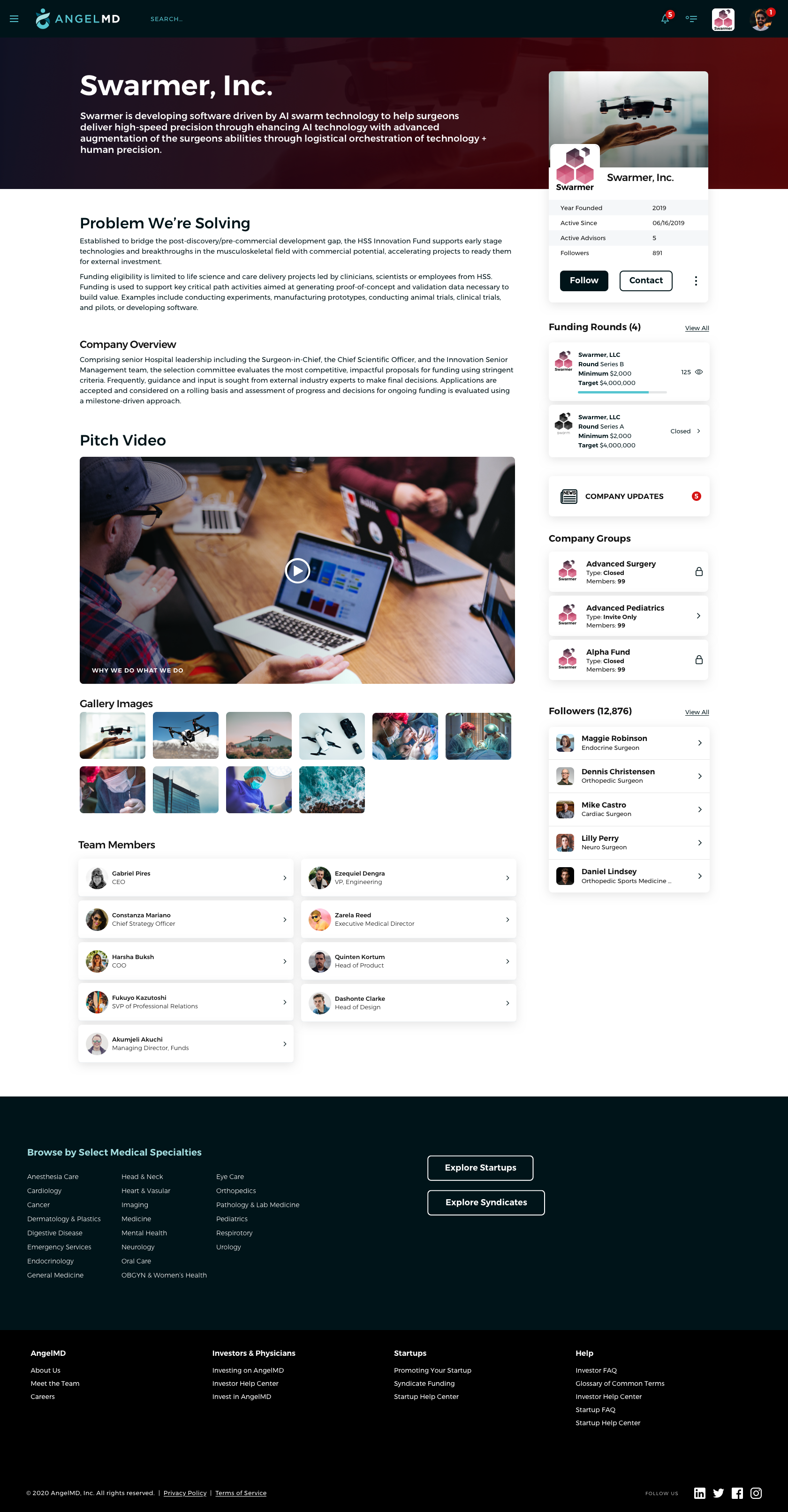
Swarmer company profile page with funding rounds, team, gallery, and company groups
Company profile page. Funding rounds history, team roster, gallery, company groups, and follower count (12,876). The company page served physicians evaluating a deal, investors tracking an existing position, and the startup managing its own presence — all in one view.

Mobile App

Deal flow and community in a dark-mode native app, scoped to your group.

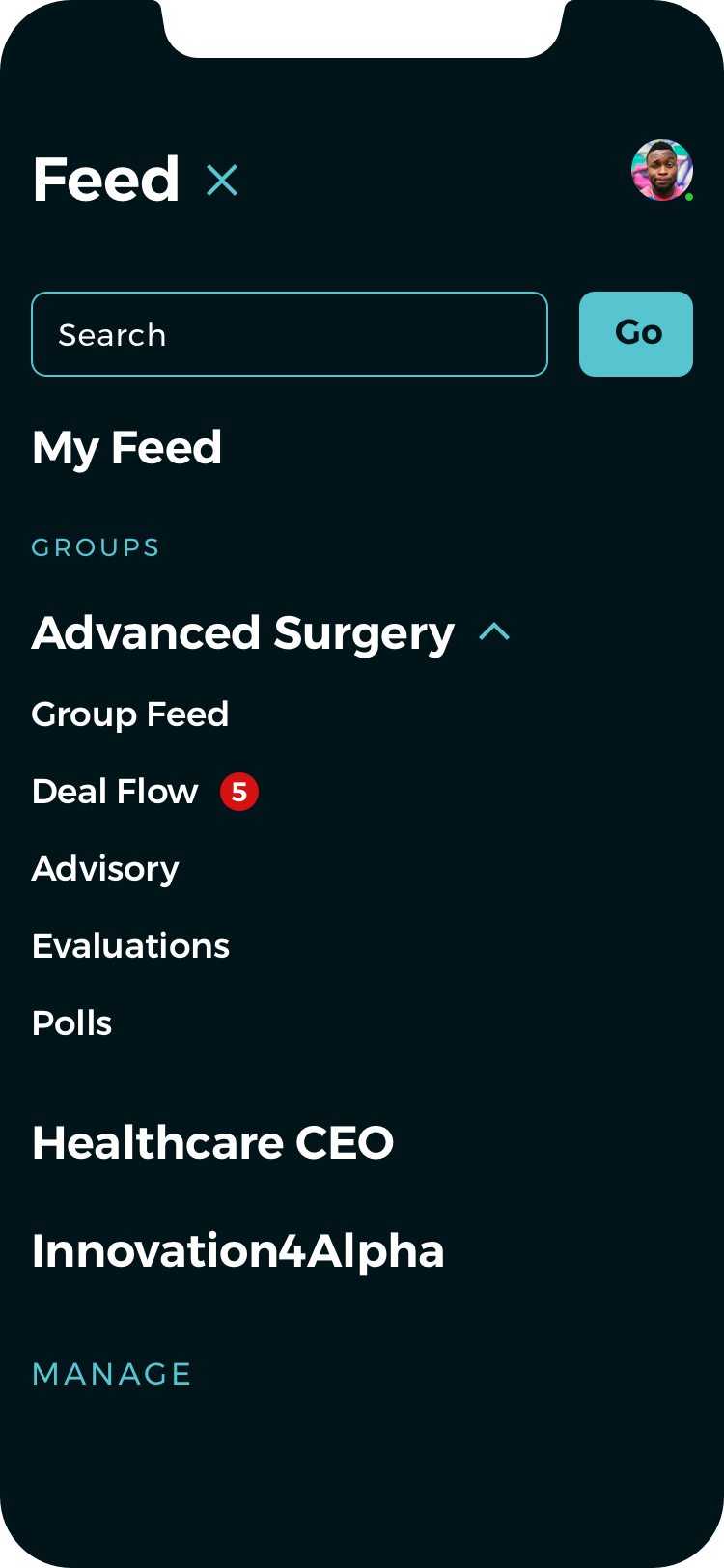
The mobile app brought the group-scoped feed and deal flow to a native experience. Context switching between groups — Advanced Surgery, Healthcare CEO, Innovation4Alpha — was built into the navigation header, giving users immediate access to the deals and community relevant to each of their professional contexts. The dark theme distinguished the app from the web platform and suited the high-focus investment context where users were reviewing deal materials on the go.
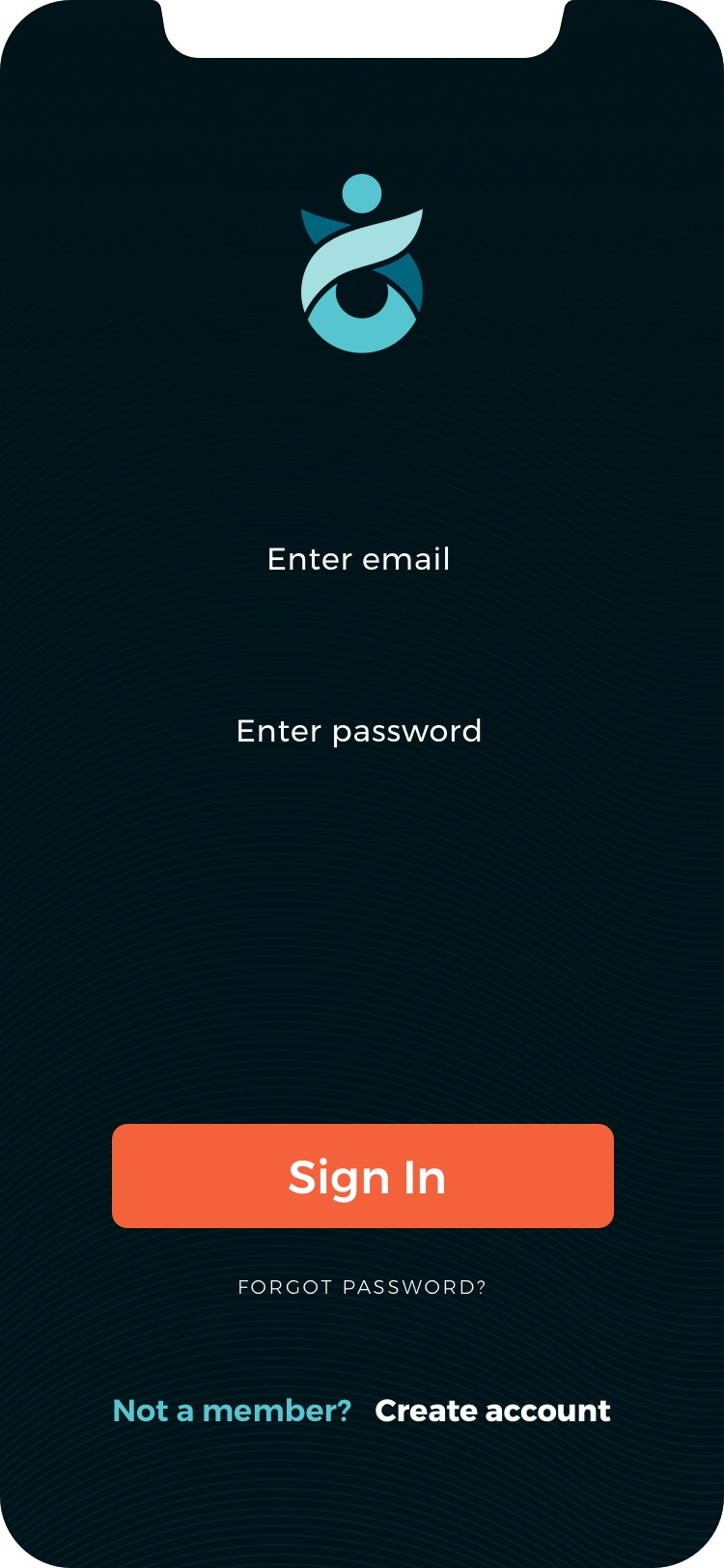
Mobile sign in dark
Sign In
Mobile menu — groups navigation
Group Nav
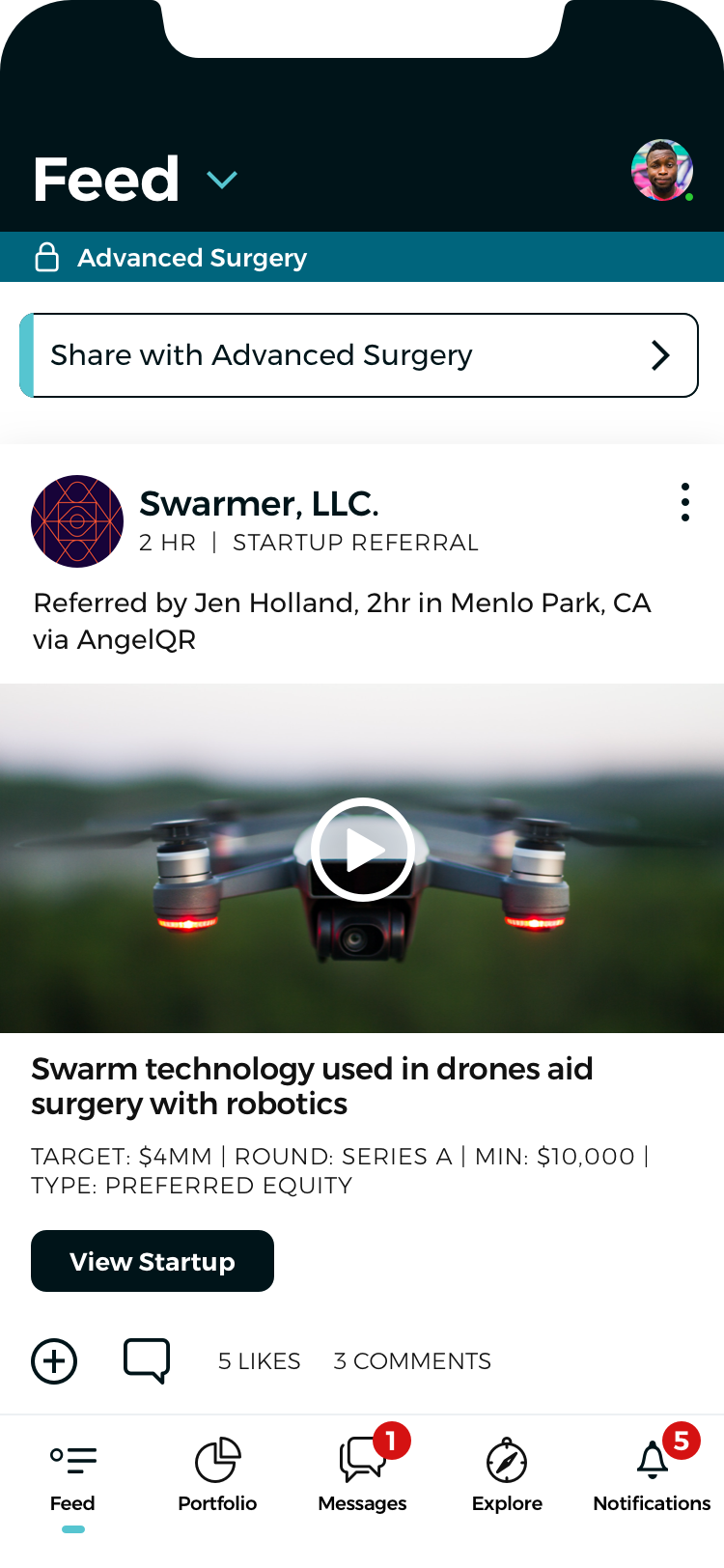
Mobile feed — Advanced Surgery group
Group Feed
Mobile deal flow — pipeline stages
Deal Flow
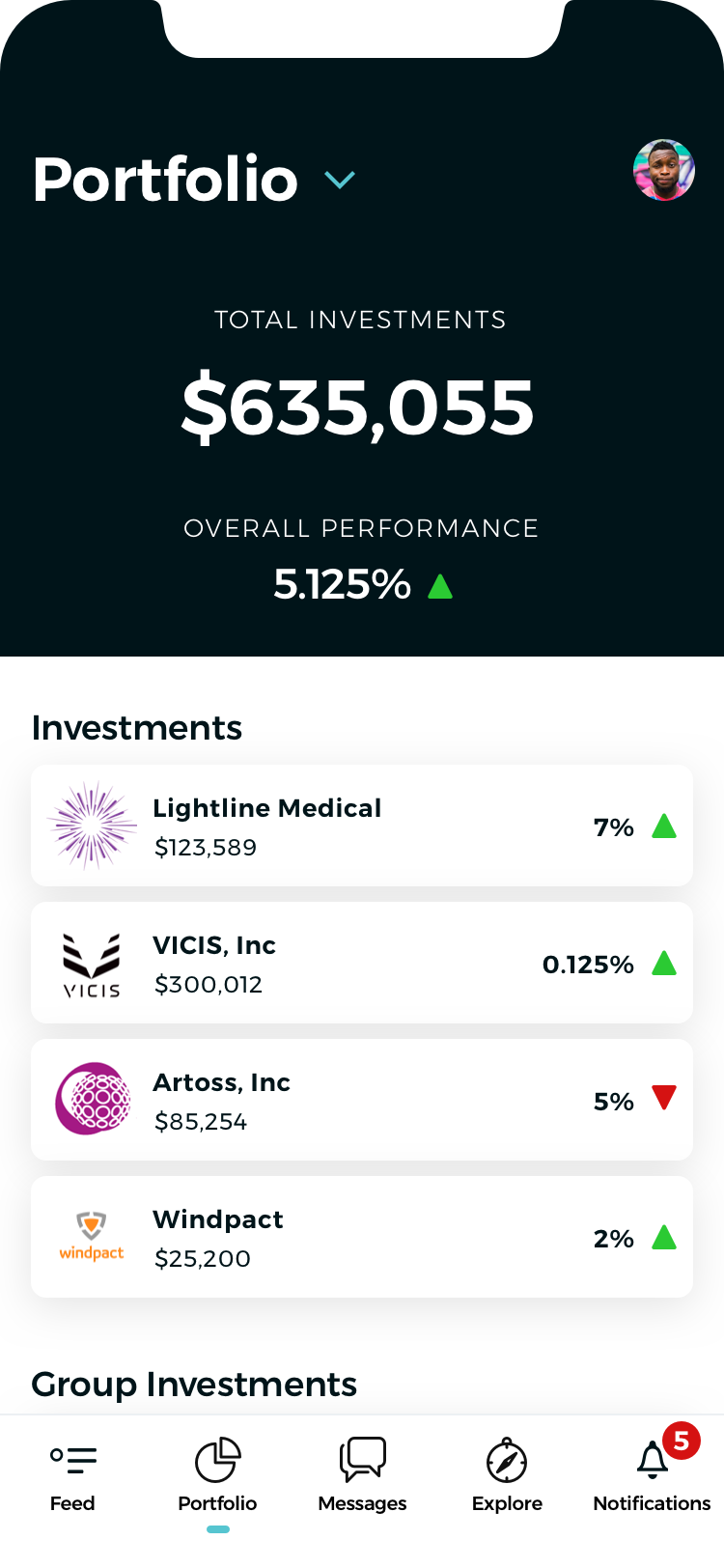
Mobile portfolio — total investments and performance
Portfolio
Mobile app — dark mode, group-scoped. Sign in → group navigation → group feed → deal flow pipeline → portfolio tracker ($635,055 total investments, 5.125% overall performance). Full investment lifecycle from discovery to portfolio management in a native mobile experience.

Beautiful product. Never saw the light of day. Here's what I learned anyway.

AngelMD was mismanaged at the leadership level — $2M burned on real estate annually while the product team shipped work that never reached users at scale. The pandemic hit in March 2020. By August, the company had stopped paying staff. I left to join DAT Freight & Analytics.

The design work was real. The account model rearchitecture was the right call and would have significantly improved activation and engagement if the company had survived long enough to ship it. The syndicate and deal flow system was genuinely differentiated for the space. The mobile app was polished and purposeful.

What the engagement taught me: design leadership isn't just about the quality of the work — it's about organizational health, financial stability, and whether leadership has the judgment to translate good design into business outcomes. The gap between exceptional design and shipped product is almost always a leadership problem, not a design problem.


Outcomes & Takeaways

Systems thinking in a chaotic environment.

In ten months — through organizational dysfunction, missed payroll, and a global pandemic — the design work produced a complete platform redesign across web and mobile, a rearchitected account model that solved a structural UX problem the original team had never identified, and a group investment experience that understood the social and clinical dynamics of physician-investor communities.

Account
model
Rearchitected from role-as-identity to Base Account + role layers — solving the hybrid physician-investor problem at the structural level.
Deal flow
Full pipeline redesign — Referrals through Invest Ready — scoped to physician specialty groups where clinical judgment was embedded in diligence.
Syndicate
Group investment UX with live progress, active/closed state design, and a company profile that served three distinct user types simultaneously.
Mobile
Dark-mode native app with group-scoped feed, deal flow pipeline, and portfolio tracker — built for how physician-investors actually engaged on the go.
View all work
Back to portfolio
View all case studies →